

 26
Progress Report on SDG 7: Affordable and Clean Energy for Academic Year 2025-2026
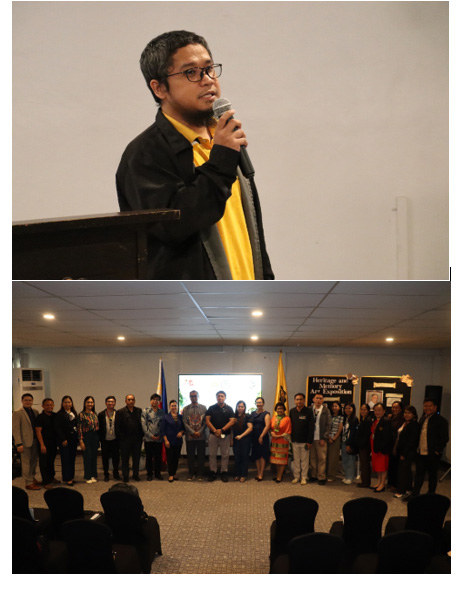
The report on SDG 7: Affordable and Clean Energy was presented by Engr. Murphy Saumat,
faculty member of the College of Engineering and Technology at Misamis University, on
October 30, 2026, during the 17 UN Sustainable Development Goals (SDG) Validation.
Participants included deans, administrators, faculty members, students, stakeholders, alumni,
and guests from the Department of Environment and Natural Resources Provincial Office, the
Department of Agriculture-Ozamiz City, the Disaster Risk Reduction and Management Office
(DRRMO)-Ozamiz City, the Economic Enterprise Development Office (CEEDO)-City
Government of Ozamiz, the Tourism Office-Ozamiz City, and provincial and city libraries. The
event was held at the Function Hall on the Misamis University campus in Ozamiz City.
The overall report is as follows:
Energy efficiency and carbon management
MU reports having implemented an Energy-Efficient Building Design, Construction, and Renovation Policy and Procedure in 2025. The policy is intended to ensure that new construction, renovations, and building upgrades follow energy-efficiency standards. The University also reports improvements to existing facilities during AY 2025–2026. These include installing solar panels across campus buildings, the Activity Center, and the Medical Center; replacing conventional bulbs with LED lighting; and integrating inverters into air- conditioning equipment. An institutional energy-efficiency plan and an energy audit study are also listed among the University’s initiatives.
To address emissions, MU reports a carbon-management program and measures to reduce vehicle-related emissions. These include regulating vehicular entry to limit idling and encouraging students and personnel to use electric scooters and bicycles. The University also lists a Fossil Fuel Divestment, Low-Carbon Financial Stewardship, and Sustainable Investment Policy and Procedure, created in 2025, along with solar-energy policies. These indicate an institutional commitment to prioritizing lower-carbon energy. The reported shift toward solar power should be distinguished from financial divestment from fossil-fuel investments, which is a separate matter.
Measuring energy use
MU reports completing an Energy Density Study covering its main campus. The study recorded an average energy use intensity of 16.22 kWh/m²/year—also reported as 58.40 MJ/m²/year—across 37,000 m² of gross floor area in 11 major building complexes. The University also reports a weighted average power density of 41.65 W/m². For the 12-month monitoring cycle from September 2025 to August 2026, MU reports total institutional energy use of 916,980 kWh (3,301.13 GJ). This comprises:
600,180 kWh (2,160.65 GJ) of imported grid electricity, or 65.45% of total use. 316,800 kWh (1,140.48 GJ) of on-site solar electricity, or 34.55% of total use.
The solar electricity was generated by reported rooftop photovoltaic facilities with a combined capacity of 250 kWp. The supplied data also estimates that this generation avoids 225.56 metric tons of CO?e annually. These figures provide a useful baseline for tracking energy performance. Their interpretation depends on consistent measurement boundaries, verified meter data, and clear documentation of which buildings and energy sources are included.
Community engagement and support for clean energy
MU reports extending energy education and technical support beyond campus. On October 13,
it held a Residential Solar PV & Smart Lighting Guide: Community Extension Seminar at Barra
Elementary School for residents of Barangay Barra, Tudela, and local industry representatives.
The seminar covered household energy profiling, solar-system sizing, battery options, LED
lighting, electricity-bill reduction, and electrical safety.
On February 10, 2026, the University held a public ceremony highlighting its campus solar initiative. The event included an open forum led by WeGen Company on the role of solar energy, followed by recognition of departments and offices using solar power. The University also reports providing direct services to the local sector through its Community Extension Solar Light project and CBM Eco Innovations program. In addition, MU lists a policy and procedure for providing government advisory, technical assistance, and policy support on clean energy and energy-efficient technologies, with a stated focus on local government. CBM Eco Innovations is also described as supporting low-carbon entrepreneurship.
Overall assessment
MU’s reported progress on SDG 7 is supported by a combination of institutional policies,
building upgrades, campus solar generation, energy-use monitoring, and community outreach.
The reported solar contribution, 34.55% of total institutional energy use during the stated 12-
month monitoring period, is a significant measure of progress, while the Energy Density Study
establishes a baseline that can guide future improvements.

Announcement

|

|

|
Photo Gallery
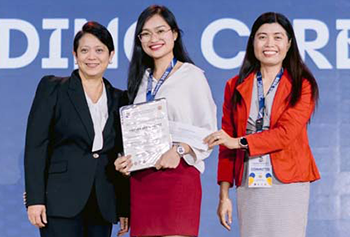 International Conference on Social Sciences 2026 |
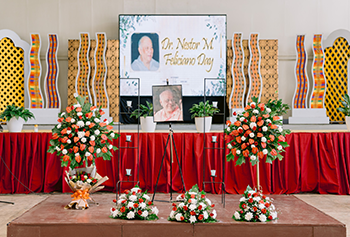 DR. NESTOR M. FELICIANO DAY |
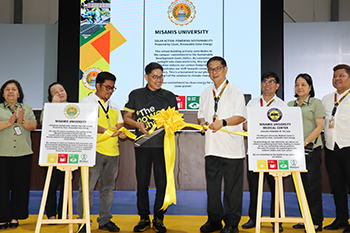 Turnover of solar energy management from WEGEN to MU |
Videos

|

|

|