

 35
EVERY DROP HAS A GREATER PURPOSE: MISAMIS UNIVERSITY'S COMMITMENT TO WATER REUSE AND SUSTAINABLE WATER MANAGEMENT
Water sustainability goes beyond conserving what is available. It involves managing resources responsibly, identifying opportunities for reuse, and ensuring that available water serves meaningful purposes beyond its immediate use. For universities, this responsibility calls for institutional policies and practical initiatives that promote resource efficiency while recognizing the importance of water in supporting both campus operations and community needs.
At Misamis University, this commitment is formalized through its Institutional Policy on Water, Sanitation, Wastewater Management, and Sustainable Water Resources. The policy establishes the University's responsibility to protect water resources, promote responsible water use, strengthen wastewater management, and integrate sustainable water practices into its institutional operations.
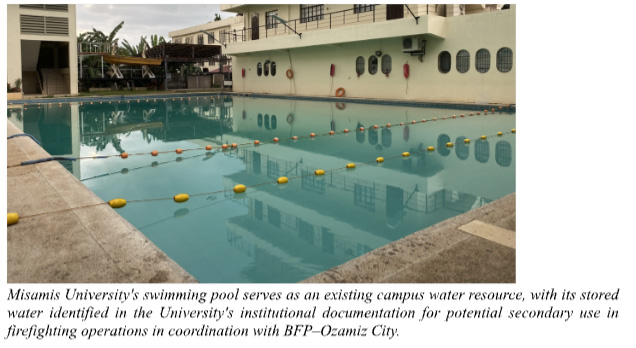
A notable example is the University's swimming pool water arrangement involving the Bureau of Fire Protection (BFP)–Ozamiz City. Beyond its primary recreational purpose, the swimming pool's stored water is identified in the University's institutional documentation as a potential supplementary source for firefighting operations during emergencies. This arrangement reflects the University's recognition that existing water resources can have additional value when responsibly managed and considered for appropriate secondary uses. Through this initiative, Misamis University demonstrates how institutional water stewardship can extend beyond campus operations and contribute to broader community preparedness.
Giving Stored Water a Second Purpose
Water resources can serve purposes beyond their original function. When properly assessed and managed, available water can contribute to other essential needs while promoting responsible resource utilization.
At Misamis University, the documented arrangement involving the swimming pool and BFP–Ozamiz City illustrates this principle. While the swimming pool primarily supports recreational activities, its stored water is identified as a potential additional source for firefighting during emergencies, subject to the necessary authorization, safety, and operational requirements. This approach highlights the importance of recognizing the value of existing campus resources and exploring responsible opportunities for their secondary use. It also reflects the University's commitment to resource efficiency and collaboration with local emergency-response authorities.
EVERY DROP HAS A GREATER PURPOSE: MISAMIS UNIVERSITY'S COMMITMENT TO WATER REUSE AND SUSTAINABLE WATER MANAGEMENT
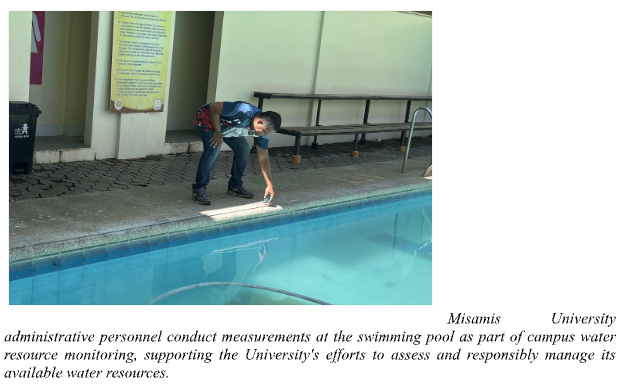
Responsible water management requires more than policies and infrastructure. It also involves regular monitoring, personnel participation, and proper documentation to support informed resource management decisions.
Misamis University's engineering personnel undertake measurements at the swimming pool as part of the University's water resource monitoring activities. Their involvement highlights the importance of technical personnel in overseeing campus facilities, assessing available resources, and supporting the implementation of institutional water-management practices. Through these monitoring activities, the University strengthens its capacity to oversee its water resources and establish a basis for documenting their availability and potential secondary use. This reflects an institutional approach in which responsible water management is supported by personnel involvement, facility oversight, and continuing improvement.
Connecting Campus Resources with Community Emergency Preparedness
Sustainable water management becomes more meaningful when institutional initiatives
recognize their potential contribution beyond campus boundaries.
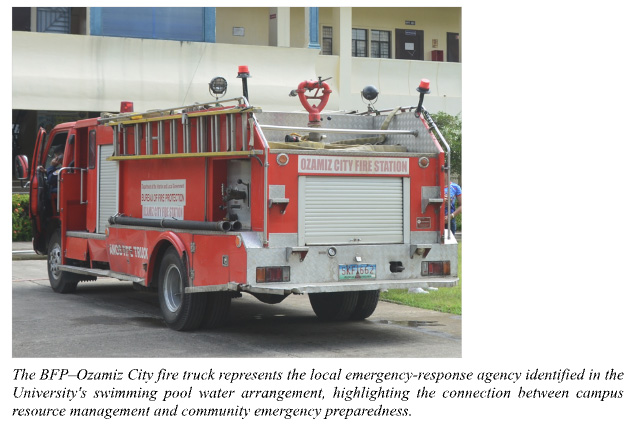
The University's documented swimming pool water arrangement identifies BFP–Ozamiz City as its local emergency-response partner. This connection underscores the importance of coordination between educational institutions and public safety agencies in identifying resources that may support emergency operations.
By recognizing the potential of stored swimming pool water as an additional firefighting source, Misamis University demonstrates how campus resources can be considered in a broader approach to community preparedness. The arrangement reflects the University's recognition that environmental responsibility and community safety can be complementary institutional priorities.
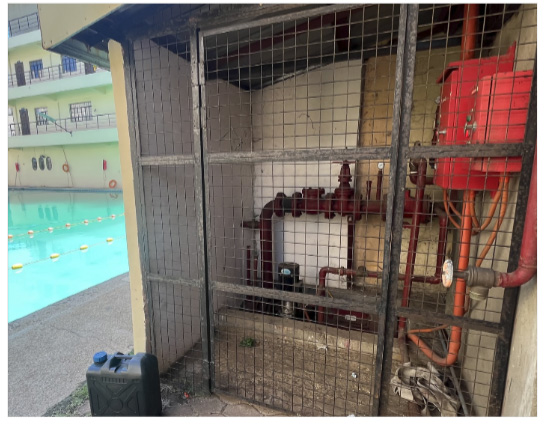
Supporting this arrangement is the University's water pumping and distribution infrastructure. Appropriate connections, pumping capacity, accessibility, and operational compatibility are important considerations in determining whether stored water can be safely made available for emergency firefighting.
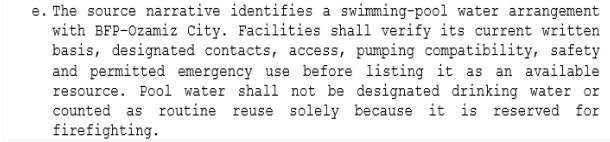
To ensure responsible implementation, the University's institutional policy requires verification of the arrangement's written basis, designated contacts, authorized access, pumping compatibility, safety requirements, and permitted emergency use before the swimming pool is identified as an available firefighting resource. These safeguards underscore the University's commitment to ensuring that water-management arrangements are supported by appropriate planning and operational accountability.
A Formal Policy for Sustainable Water Management
Behind the University's water-management initiatives is a formal institutional commitment that provides direction and establishes responsibility across its operations.
Misamis University's Institutional Policy on Water, Sanitation, Wastewater Management, and Sustainable Water Resources establishes a framework for protecting water resources, ensuring adequate sanitation, managing wastewater responsibly, and promoting sustainable water use throughout the University.
The policy outlines institutional responsibilities, operating procedures, monitoring mechanisms, emergency actions, and verification of results. It also recognizes water and sanitation as essential conditions for educational delivery and integrates their management into the University's Educational Organizations Management System (EOMS).
By establishing a university-wide policy, Misamis University makes responsible water management an institutional responsibility rather than an isolated environmental activity. It provides direction for integrating water conservation, resource monitoring, wastewater management, and emergency preparedness into the University's continuing operations.
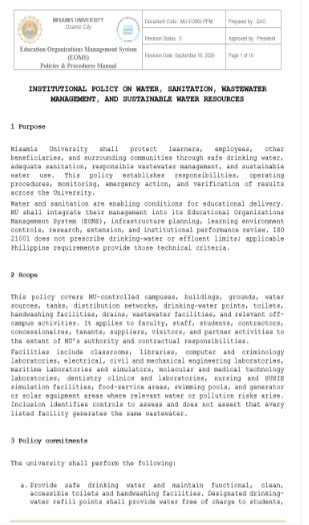
A particularly relevant provision of the policy addresses the swimming pool water arrangement with BFP–Ozamiz City. It recognizes the potential emergency use of stored pool water while requiring the verification of the necessary authorization, accessibility, pumping compatibility, safety, and operational arrangements.
Making Water Stewardship a Shared Responsibility
For Misamis University, sustainable water management is not limited to reducing consumption
or maintaining campus facilities. It involves developing responsible practices, monitoring
available resources, identifying appropriate opportunities for secondary use, and recognizing
how institutional resources may contribute to the needs of the wider community.
Through its institutional policy, administrative personnel involvement, existing facilities, and documented arrangement with BFP–Ozamiz City, the University demonstrates an approach to water stewardship that connects institutional resource management with community preparedness and environmental responsibility.
The swimming pool water arrangement illustrates how an existing campus resource can be considered for a purpose beyond recreation, while the University's institutional policy provides the framework for ensuring that such arrangements are pursued responsibly and with appropriate safeguards. For Misamis University, water sustainability is more than a policy commitment—it is a continuing institutional responsibility reflected in the way available resources are managed and opportunities for responsible reuse are recognized.
Because every drop matters, and every responsible decision about water contributes to a more sustainable and resilient future.

Announcement

|

|
|
Photo Gallery
 International Conference on Social Sciences 2026 |
 DR. NESTOR M. FELICIANO DAY |
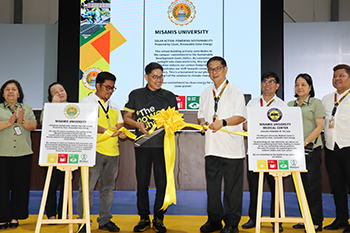 Turnover of solar energy management from WEGEN to MU |
Videos

|

|

|