

 29
Misamis University Physical Space Inventory and Spatial Energy Load Cross-Referencing Program
Misamis University conducted a campus-wide space and energy assessment to establish a baseline for SDG 7.3.2 reporting and improve energy planning. The program linked building floor area with electrical demand and cooling loads, helping distinguish energy use caused by space size and function from potential operational inefficiencies.
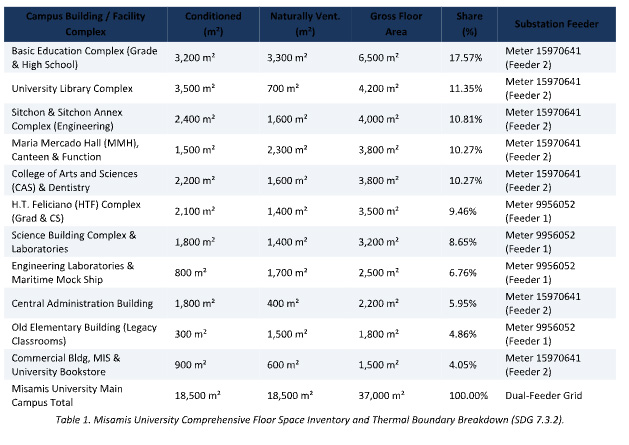
The study covered the university’s 7.5-hectare main campus in Ozamiz City. Across 11 building complexes, the team documented 37,000 m² of gross floor area: 18,500 m² of conditioned space, 14,200 m² of naturally ventilated space, and 4,300 m² of service and circulation areas. Monitoring ran from September 2025 through August 2026, with results consolidated in October 2026.
The Physical Plant Office, Campus Planning, and College of Engineering and Technology used digitized floor plans, satellite measurements, feeder records, and room-level energy audits. They classified spaces by use and thermal conditions, mapped areas to two electrical feeders, and calculated power density (W/m²) and annual energy intensity (kWh/m²/year). Cooling loads in Sitchon Annex and Sitchon Building were also compared with room floor areas.
Engineering students carried out the surveys and calculations with guidance from faculty and facilities staff. The results are the following:
1. Comprehensive Campus Floor Space Inventory (SDG 7.3.2 Baseline)
The primary output was a campus-wide floor-space inventory linking the university’s built
environment to its energy-monitoring framework. The inventory established that Misamis
University has 37,000 m² of GFA across 11 building complexes on its 7.5-hectare main campus.
The study also produced a classification of campus space by thermal condition and functional
use, mapped floor area to the two primary electrical feeders, and established a method for
calculating building- and room-level energy intensity. The room-level analysis of Sitchon Annex
and Sitchon Building provided a basis for comparing cooling demand with the floor area served.
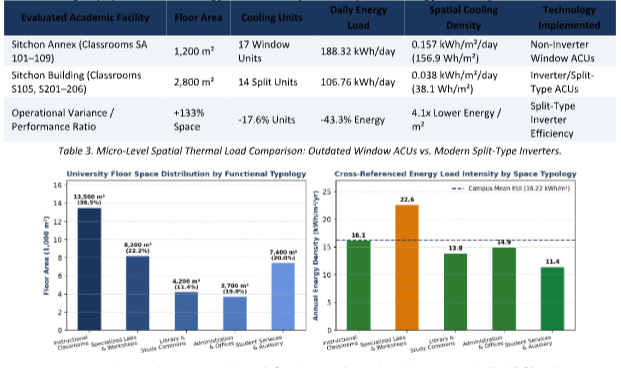
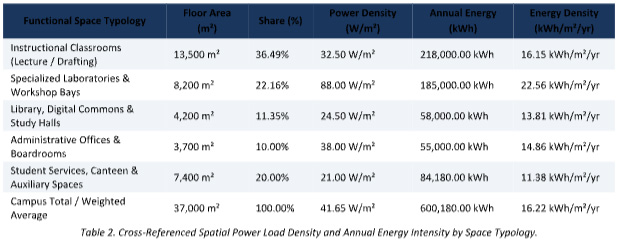
2. Space Typology and Electrical Load Density Cross-Referencing>
Cross-referencing functional space typologies with empirical energy consumption revealed
significant variations in power density:
3. Micro-Level Thermal Space Load Analysis: Sitchon Annex vs. Sitchon Building
Cross-referencing detailed ACU energy audit data with classroom floor space demonstrated
how cooling equipment technology dramatically alters spatial energy intensity:
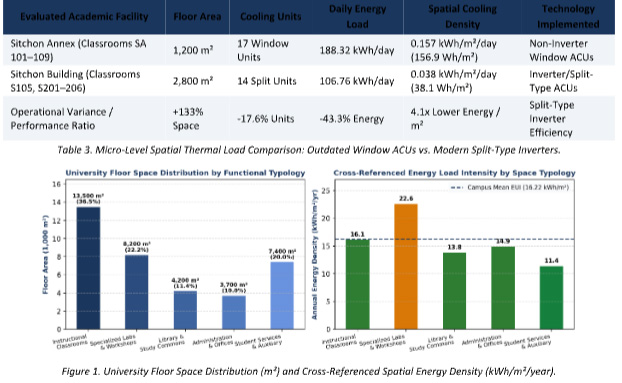
Further analysis revealed differences in energy use across campus spaces. Specialized laboratories and workshops make up 22.16% of campus floor area but account for 30.82% of electricity use, with an intensity of 22.56 kWh/m²/year. Cooling demand also varied substantially: Sitchon Annex window units used 0.157 kWh/m²/day, compared with 0.038 kWh/m²/day for Sitchon Building split units. With more than 8,000 students using 37,000 m² of floor space, the campus provides approximately 4.625 m² per student.
These findings informed several institutional actions. The university established an auditable floor-area baseline linked to energy data for SDG 7.3.2 reporting and introduced scheduling guidance favoring more energy-efficient buildings for intensive daytime classes. The results also supported a plan to replace 17 window air-conditioning units in Sitchon Annex with inverter split units, with projected savings of 16.96 kWh per day. In addition, spatial power-density benchmarks are being incorporated into future building guidelines, while emissions normalized by floor area will help track the campus’s spatial carbon intensity over time.
Student engineering researchers Baludo, Talaruc, and Cortedor reflected: “Connecting physical room dimensions and electrical telemetry taught us how architectural design directly impacts electrical power consumption, providing practical insight for our future engineering careers.

Announcement

|

|

|
Photo Gallery
 International Conference on Social Sciences 2026 |
 DR. NESTOR M. FELICIANO DAY |
 Turnover of solar energy management from WEGEN to MU |
Videos

|

|

|