

 33
WATER CARE IN ACTION: How Misamis University Advances Responsible Water Management and Conservation
Every drop matters. Through accessible drinking-water facilities, water quality monitoring, water- efficient infrastructure, responsible wastewater management, and sustainable campus practices, Misamis University demonstrates its commitment to protecting water resources and promoting a healthier, more sustainable campus.
Water is fundamental to human health, environmental protection, and the sustainable operation of educational institutions. It supports essential campus activities, from drinking and sanitation to laboratory operations and the maintenance of green spaces. Ensuring its responsible use requires more than simply reducing consumption; it calls for effective management, pollution prevention, water quality monitoring, and institutional practices that safeguard this vital resource.
At Misamis University (MU), responsible water management is translated into concrete initiatives integrated into campus operations. Through accessible drinking-water facilities, regular monitoring of water potability, water-efficient infrastructure, responsible laboratory wastewater management, and environmentally conscious landscaping, the University demonstrates how water stewardship can be incorporated into everyday institutional practices. These initiatives reflect MU's continuing commitment to protecting water quality, promoting efficient resource use, and providing a healthier environment for its academic community.
MANAGING WASTEWATER RESPONSIBLY: STRENGTHENING WATER QUALITY PROTECTION THROUGH PROPER TREATMENT
Protecting water resources requires attention not only to water consumption but also to the proper management of wastewater generated through institutional activities. In laboratory settings, wastewater requires appropriate treatment and handling to help minimize potential environmental contamination before disposal.
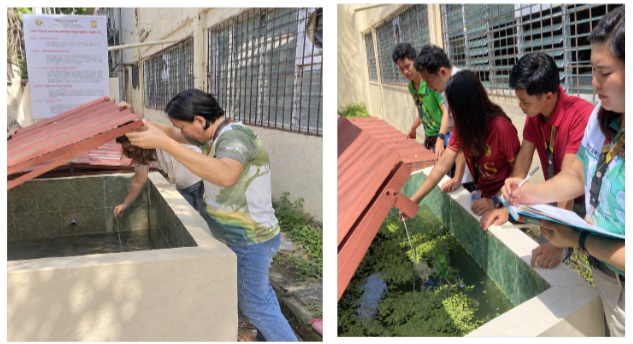
In support of this responsibility, Misamis University operates a five-stage wastewater treatment facility at its Natural Science Laboratory, designed to support the proper treatment and management of wastewater generated from laboratory activities before disposal. This facility forms part of the University's efforts to address potential sources of water pollution and strengthen environmental safeguards within its laboratory operations.
To support its continued operation and oversight, the facility undergoes regular monitoring and inspection involving the Pollution Control Officer, Department Chair, Laboratory-in-Charge, laboratory technicians, and laboratory staff. Their collective involvement reinforces institutional accountability and helps ensure that wastewater management remains an integral part of laboratory operations.
More than a wastewater treatment installation, this facility demonstrates MU's recognition that protecting water resources begins with responsible management at the institutional level. By providing a dedicated treatment facility and establishing personnel oversight, the University puts environmental responsibility into practice and strengthens its commitment to water quality protection
KEEPING WATERWAYS CLEAN: MOBILIZING THE UNIVERSITY AND COMMUNITY FOR WATER POLLUTION PREVENTION
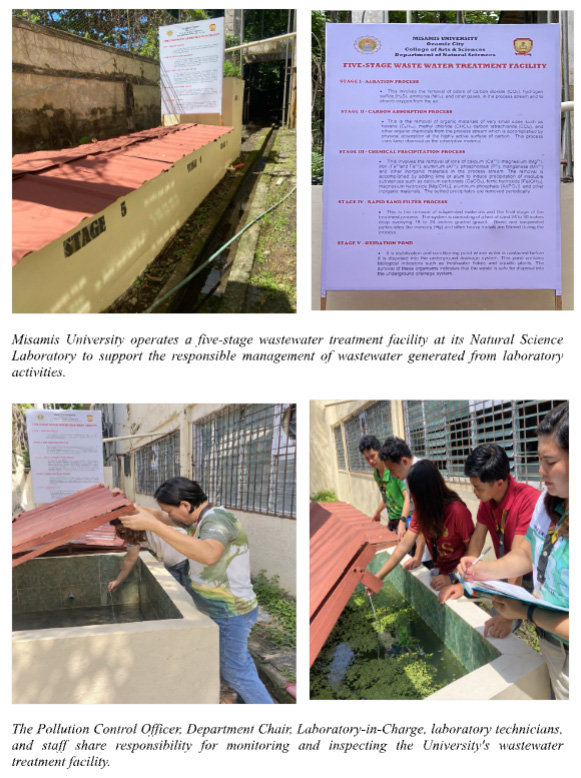
Protecting water resources requires collective action that extends beyond the university campus. Preventing waste from entering esteros, rivers, and other waterways is essential to reducing pollution and safeguarding the environment. Recognizing that environmental protection is a shared responsibility, Misamis University (MU) promotes active participation in initiatives that encourage cleaner surroundings and the responsible management of waste.
Through its Community Extension Program Office, in collaboration with various colleges and departments, the University conducts cleanup drives along esteros and other waterways. These activities bring together university personnel, students, and community members in removing improperly discarded waste and helping prevent pollution in shared water environments. Beyond the immediate cleanup efforts, these initiatives encourage environmental awareness, civic participation, and a shared commitment to protecting local water resources.
Within the University, the commitment to pollution prevention is reinforced through institutional policies and environmental awareness initiatives. The Vice President for Administration oversees the implementation of the Clean as You Go (CLAYGO) policy, which encourages students and personnel to dispose of waste properly and maintain cleanliness in common areas. This practice helps minimize the improper disposal of waste that could eventually contribute to environmental pollution.
Environmental responsibility is further integrated into university-wide information and awareness activities. The Director for Student Affairs incorporates environmental awareness into first-semester college orientations, while the Human Resource Department promotes similar awareness among faculty and staff through general assemblies. These initiatives help communicate the importance of proper waste disposal, environmental stewardship, and individual accountability across different sectors of the University.
Through community cleanup activities, campus cleanliness policies, and environmental education, Misamis University strengthens a culture of shared responsibility for protecting water resources. These efforts demonstrate that preventing water pollution is not confined to a single program or department; it requires sustained institutional support and the active participation of the entire university community. Ultimately, keeping waterways clean begins with responsible everyday practices and collective action.
SAFE DRINKING WATER WITHIN REACH: ENSURING ACCESS TO SAFE AND POTABLE WATER ON CAMPUS
Access to safe drinking water is essential to protecting health, supporting well-being, and creating a conducive learning and working environment. Within a university campus, reliable access to drinking water is particularly important, as students, faculty, staff, and visitors depend on these facilities throughout their daily activities.
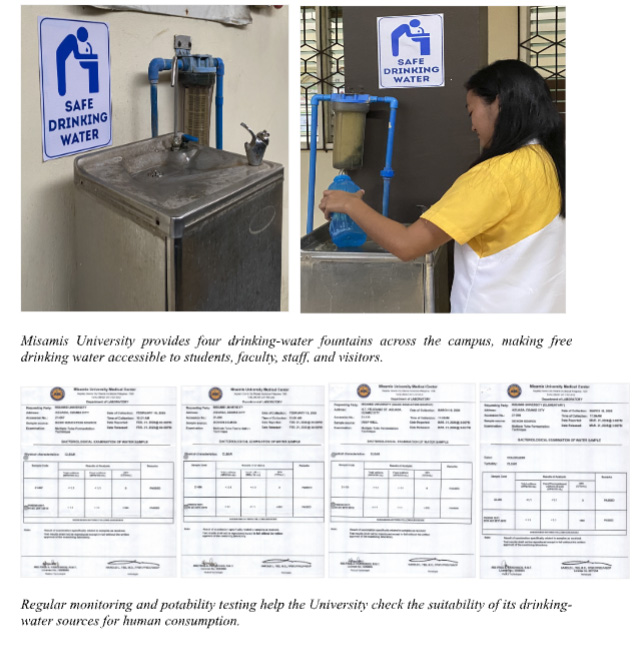
Recognizing this need, Misamis University (MU) provides four drinking-water fountains strategically located across the campus, offering free drinking water to students, faculty, staff, and visitors. These facilities promote convenient access to drinking water and support the University's commitment to maintaining a healthy and supportive campus environment.
Beyond making drinking water accessible, the University recognizes that its safety and suitability for human consumption must be consistently safeguarded. Accordingly, MU regularly monitors and conducts potability testing of its drinking-water sources to assess their suitability for consumption. Routine monitoring and testing also help identify potential concerns and support the continued provision of water suitable for human consumption. Through accessible drinking-water facilities, regular potability monitoring, and institutional attention to water safety, Misamis University demonstrates its commitment to promoting access to safe drinking water within its campus. These initiatives go beyond providing a basic campus facility; they reflect the University's responsibility to protect the health, welfare, and everyday well-being of the people it serves.
PROMOTING WATER CONSERVATION THROUGH WATER-EFFICIENT CAMPUS FACILITIES
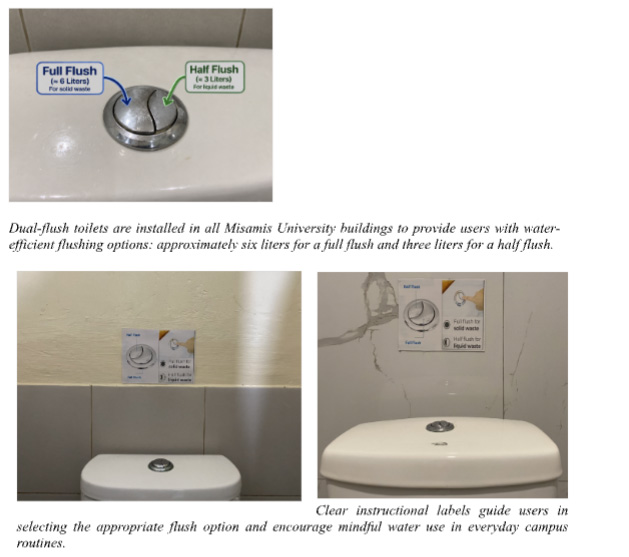
Water conservation becomes more effective when responsible water use is integrated into the facilities and practices that support everyday campus activities. At Misamis University (MU), this commitment is reflected in the installation of dual-flush toilet systems in all university buildings, incorporating water-efficient features into the University's campus infrastructure.
These fixtures provide users with two flushing options, allowing them to select the amount of water appropriate to their needs. The full-flush option consumes approximately six liters of water, while the half-flush option uses approximately three liters. By providing these alternatives, the University encourages more efficient water consumption and gives users the opportunity to avoid unnecessary water use. Instructional labels placed near the flush controls further guide users in selecting the appropriate flushing option.
Beyond the installation of water-efficient fixtures, MU recognizes the importance of encouraging individual participation in conservation efforts. The instructional labels serve as practical reminders that responsible water use is a shared responsibility and that everyday decisions can contribute to more efficient resource consumption. Through the installation of dual-flush toilets across all its buildings and the provision of clear usage instructions, Misamis University integrates water conservation into its campus infrastructure and daily routines. This initiative demonstrates how practical facility improvements, combined with responsible user behavior, can support the University's broader commitment to sustainable water management.
GROWING A GREENER CAMPUS: PROMOTING WATER-EFFICIENT LANDSCAPING AND BIODIVERSITY
Responsible water management extends beyond campus buildings and facilities to the way outdoor spaces are designed, maintained, and sustained. The selection of appropriate trees and ornamental plants plays an important role in creating environmentally responsive landscapes, maintaining green spaces, providing natural shade, and supporting campus biodiversity. By considering the water requirements and adaptability of plants, universities can promote greener surroundings while being mindful of water consumption.
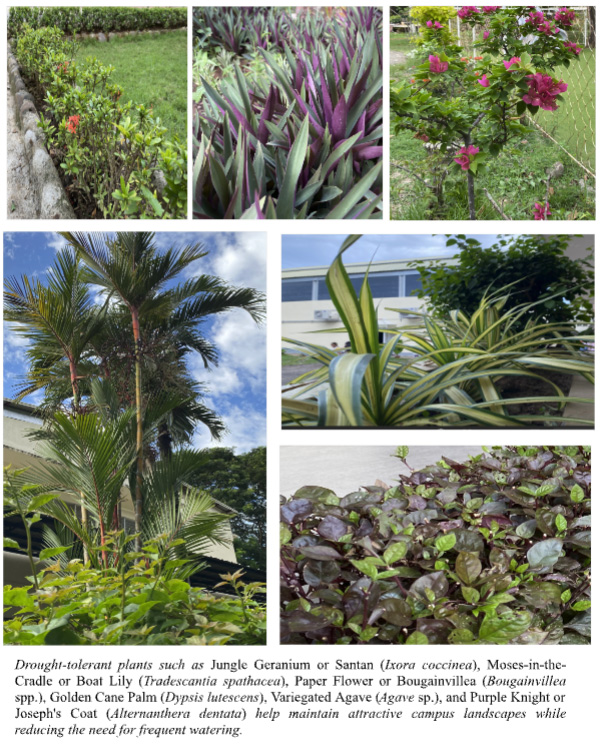
At Misamis University (MU), water-conscious and climate-responsive landscaping is reflected in the presence of native Philippine trees and drought-tolerant ornamental plants across the campus. Among the trees found within the University grounds are Molave (Vitex parviflora), Narra (Pterocarpus indicus), Balete (Ficus spp.), and Acacia (Samanea saman). The University's landscaped areas also feature ornamental plants with varying degrees of drought tolerance, including Jungle Geranium or Santan (Ixora coccinea), Moses-in-the-Cradle or Boat Lily (Tradescantia spathacea), Paper Flower or Bougainvillea (Bougainvillea spp.), Golden Cane Palm (Dypsis lutescens), Variegated Agave (Agave sp.), and Purple Knight or Joseph's Coat (Alternanthera dentata).
The selection of plants that can tolerate periods of limited water availability helps support the maintenance of campus landscapes while potentially reducing the need for frequent irrigation. In addition, the University recognizes the environmental value of preserving its mature and century- old trees. These established trees provide natural shade, help moderate campus temperatures, contribute to biodiversity, and enhance the overall environmental quality of the University grounds.
Through appropriate plant selection and the preservation of established trees, Misamis University demonstrates an approach to campus landscaping that considers both environmental quality and resource conservation. These practices reflect the University's commitment to maintaining greener outdoor spaces while promoting a healthier, more climate-responsive, and environmentally sustainable campus.
For Misamis University, caring for water goes beyond campus practices—it is about building a community that understands the value of every drop and takes part in protecting this precious resource. Through simple, consistent actions and a shared sense of responsibility, the University continues to nurture a campus where caring for the environment becomes part of everyday life and helps create a better, more sustainable future for generations to come.

Announcement

|

|
|
Photo Gallery
 International Conference on Social Sciences 2026 |
 DR. NESTOR M. FELICIANO DAY |
 Turnover of solar energy management from WEGEN to MU |
Videos

|

|

|