

 28
Misamis University Establishes Campus-Wide Energy Use Baseline
Misamis University (MU) conducted a comprehensive study to measure energy consumption across its main campus and establish a baseline for improving efficiency. The Empirical Energy Density Study and Gross Floor Area Baseline Assessment supports the university’s reporting under UN Sustainable Development Goal 7 (SDG 7), including Indicator 7.5.1 on total energy use.
The study covered MU’s 7.5-hectare campus in Aguada, Ozamiz City, encompassing an estimated 37,000 square metres of gross floor area across 11 building complexes. These facilities were grouped into two distribution zones: the Technical and Science Zone, with an estimated 15,000 m², and the Academic and Administrative Zone, with 22,000 m².
The work combined a two-month period of intensive monitoring during September and October 2025 with a 12-month annual monitoring cycle running from September 2025 through August 2026. The annual data were consolidated in October 2026. Researchers used utility billing records and substation telemetry to track electricity consumption, demand, and costs, while campus measurements and architectural and satellite references informed the floor-area estimates.
A key aim was to calculate Energy Use Intensity (EUI)—the amount of energy used per square metre—at both campus-wide and zone levels. Electricity consumption was also converted from kilowatt-hours into gigajoules using the standard conversion of 1 kWh to 0.0036 GJ. The analysis was designed to help distinguish peak instructional-period demand, including cooling loads, from consumption during quieter periods such as semester breaks.
The University Administration, Physical Plant Office, and College of Engineering and Technology collaborated on the project. Senior Electrical Engineering students carried out field surveys, telemetry logging, and spatial modelling under the guidance of faculty mentors and campus facilities personnel.
The resulting baseline is intended to support sustainability reporting, facilities planning, and future energy-efficiency measures. University leaders and facilities managers can use the data to identify unusual loads, evaluate feeder balance, optimize equipment operation, and assess the potential for rooftop solar installations. The broader goals include improving electrical service and classroom comfort while reducing energy demand and associated emissions.
Through this assessment, MU has created a framework for tracking campus energy use against building area and operational patterns—an important step toward more informed energy management and long-term decarbonization planning. The results are the following:
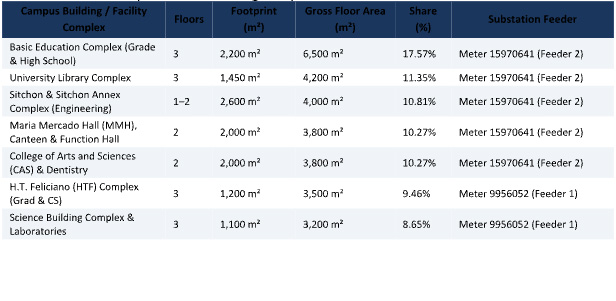
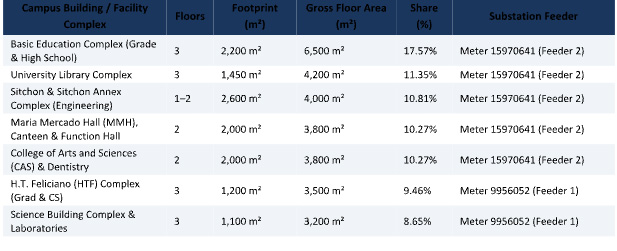
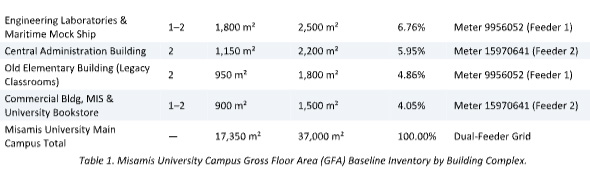
1. Campus Gross Floor Area (GFA) Baseline Inventory
Spatial mapping across the 7.5-hectare campus established an aggregate Gross Floor Area of
37,000 m² across 11 permanent building complexes:
2. September–October Intensive Energy Density Study Results
During the announced September and October 2025 study window, the university logged exact
aggregate energy consumption across both main service meters, fulfilling its institutional pledge:
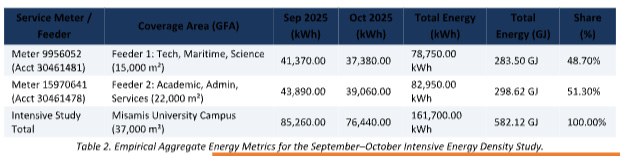
The September–October study captured 161,700.00 kWh (582.12 GJ) of energy use, representing a daily burn rate of 2,650.82 kWh/day across the 61-day period and reflecting peak academic cooling demand.
3. Official Annual Total Energy Used Baseline (SDG 7.5.1 Full-Year Metric)
Consolidating the 12-month operational cycle (September 2025 through August 2026)
establishes the official SDG 7.5.1 baseline:
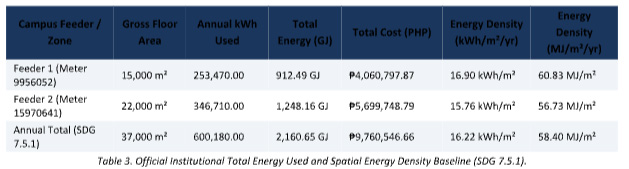
Analysis of the normalized energy data revealed differences in consumption across campus zones and classroom types. Feeder 1 recorded a higher energy density than Feeder 2—16.90 compared with 15.76 kWh/m²/year—which the study attributed to maritime simulation equipment, specialized engineering machinery, and continuous ventilation in science laboratories.
A localized audit of the Sitchon Annex also identified differences associated with classroom cooling systems. Classrooms using older window air-conditioning units recorded daily energy intensities of 0.157 kWh/m², compared with 0.038 kWh/m² in classrooms with split-type inverter units. These findings point to potential savings from targeted equipment upgrades.
Across the campus, the reported energy density was 16.22 kWh/m²/year, equivalent to 58.40 MJ/m²/year. The study presents this as a baseline for institutional comparison and identifies opportunities to improve energy management, including inverter retrofits.
The study produced several practical outcomes:
1. SDG 7.5.1 baseline: It established reported annual energy consumption of 600,180 kWh
(2,160.65 GJ) and intensive-period consumption of 161,700 kWh (582.12 GJ).
2. Solar PV assessment: The Basic Education Complex, Library, and HTF Building were
identified as potential sites for a 250 kWp solar photovoltaic system. The estimated annual
generation is approximately 320,000 kWh, which could offset more than half of grid
electricity use.
3. Facility scheduling: Energy-use ratings informed facility-specific operating schedules,
including measures to reduce unnecessary pre-cooling and coordinate laboratory
equipment use.
4. Decarbonization planning: The baseline provides a basis for tracking Scope 2 greenhouse
gas emissions, with a stated reduction target of more than 50 metric tons of CO? equivalent
annually.
5. Curricular integration: The energy-density auditing methodology was incorporated into
electrical and mechanical engineering laboratory coursework.

Announcement

|

|

|
Photo Gallery
 International Conference on Social Sciences 2026 |
 DR. NESTOR M. FELICIANO DAY |
 Turnover of solar energy management from WEGEN to MU |
Videos

|

|

|