 Linkage & Networking
 November 12, 2026 8:50 A.M.
 29
Misamis University Extends Free Educational Resources and Technology Beyond Campus
Misamis University supports inclusive and equitable access to education by sharing its learning resources, digital technologies, training, and technical expertise with communities beyond its student population. Through partnerships with public institutions and schools, the University helps strengthen digital skills, improve access to learning support, and promote lifelong learning.
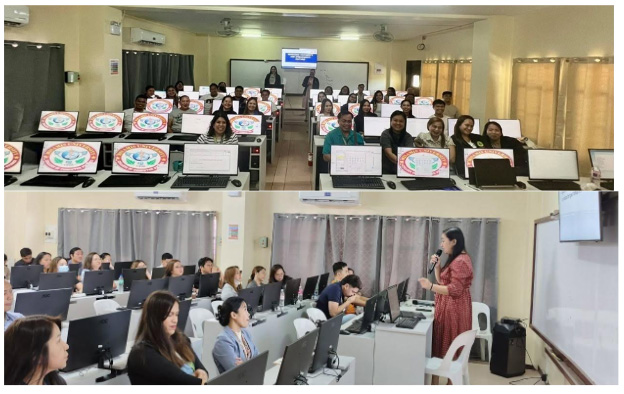
One initiative, the MHARSMC Staff ICT Capacity Building Program, provided free training to 133 government hospital staff in document and spreadsheet management, file and email management, and Google Workspace. The University contributed facilities, computers, training materials, and faculty expertise, while BSIT and BSCS students served as facilitators.
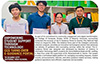
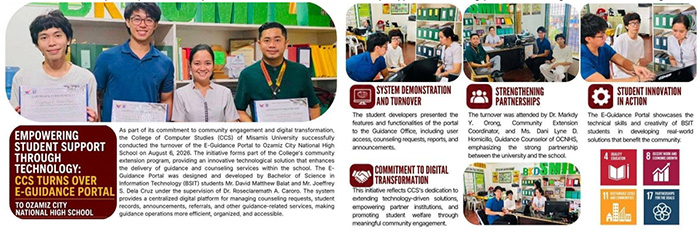
The University also supported the development of the Data-Driven E-Guidance Platform for Ozamiz City National High School. Created through a faculty-supervised BSIT capstone project and deployed on August 6, 2026, the platform offers digital counseling records, session tracking, analytics, and self-help resources for learners and guidance personnel.
Together, these initiatives illustrate how Misamis University extends educational and technological opportunities beyond campus. The articles that follow present these efforts and their contributions to digital inclusion, community engagement, and access to learning resources. Supporting documentation includes training records, attendance sheets, photographs, accomplishment reports, and system deployment and assessment reports.
Development of a Data-Driven E-Guidance Platform to Advance Counseling Practice through Integrated Modules for Inventory Management, Session Tracking, and Analytics
Misamis University, through the College of Computer Studies, integrates experiential and community-engaged learning into its Bachelor of Science in Information Technology (BSIT) program through faculty-supervised capstone projects. One example is the development and deployment of a data-driven e-guidance platform for Ozamiz City National High School (OCNHS), a public secondary school in Ozamiz City. The project was developed by BSIT students David Matthew Balat and Joeffrey De la Cruz under the supervision of Dr. Roseclaremath A. Caroro during School Year 2025–2026.
The project addressed the guidance office's need for improved management of counseling information, session tracking, inventory, reports, data analytics, and student- oriented self-help resources. Through consultations, interviews, demonstrations, system testing, and user acceptance testing, the students worked directly with the school's guidance personnel to identify requirements and develop a web-based platform. The project allowed students to apply competencies in software development, intelligent systems, fuzzy logic, natural language processing, database and system design, and system testing in an authentic educational setting.
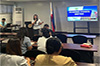
Beyond technical skills, the project developed students' professional competencies in communication, teamwork, collaboration, problem solving, requirements analysis, and responsiveness to user needs. The students conducted orientations, demonstrations, user training, and instructional sessions for partner personnel and provided user documentation and follow-up support. The resulting platform includes guidance and counseling records, session tracking, inventory management, reports and data analytics, and student-oriented self-help resources identified in coordination with the school's guidance personnel.
The platform was deployed at OCNHS on 6 August 2026, extending technology- supported guidance resources to the school's junior and senior high school students and guidance personnel beyond the university campus. The project is supported by academic and community-engagement documentation, including capstone records, course outcomes, assessment rubrics, supervision records, consultation and training documentation, photographs, deployment records, and certificates of recognition from the partner school. Overall, the project demonstrates how Misamis University connects professional computing education with community needs while providing BSIT students with meaningful real-world learning experiences.
MHARSMC Staff ICT Capacity Building
Misamis University’s College of Computer Studies (MU-CCS) provided free ICT education and learning resources to 133 administrative and office staff of the Mayor Hilarion A. Ramiro Sr. Medical Center (MHARSMC), a government hospital in Ozamiz City. Implemented through four training batches from January to November 2025 and formally completed on January 14, 2026, the program extended structured learning opportunities to external adult learners who participated as hospital employees rather than as MU students.
The program was developed based on a Training Needs Analysis (TNA) that identified the ICT competency needs of MHARSMC personnel. Training topics included Advanced Document Management, Advanced Spreadsheet Management, File Management, email management, and Google Workspace applications. Participants received training modules, presentations, demonstration files, practical exercises, and electronic learning resources, while MU-CCS provided the computers and equipment. All training, materials, certificates, and venue were provided free of charge.
The training employed presentations, demonstrations, hands-on exercises, and facilitated activities. Four batches were conducted with 31 participants on January 9–10, 2025; 31 on September 12, 2025; 35 on September 25–26, 2025; and 36 on November 27–28, 2025, all held at the CCS Computer Applications Learning Center. Six MU-CCS faculty members served as resource speakers, while 15 BSIT and BSCS students assisted as facilitators, providing participants with practical support while gaining supervised experience in technology-based learning.
The program generated documented evidence through attendance records, training outputs, exercises, participant feedback, certificates, photographs, training materials, and accomplishment reports, supported by the program proposal, request, MOA, and other activity records. While long-term workplace impact has not yet been formally measured, MU-CCS plans a subsequent impact assessment. Overall, the program demonstrates Misamis University’s commitment to extending free, structured ICT learning, equipment, educational resources, and faculty expertise to external adult learners in response to their workplace and digital productivity needs.

Announcement
|
|
|
Photo Gallery
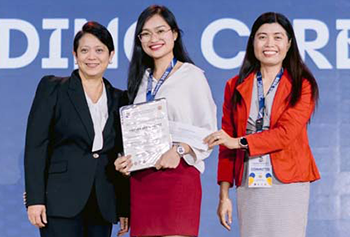 International Conference on Social Sciences 2026 |
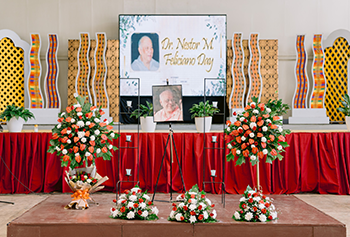 DR. NESTOR M. FELICIANO DAY |
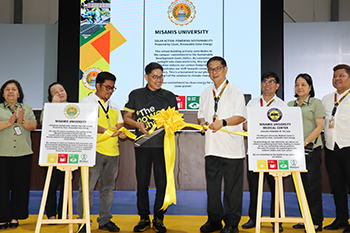 Turnover of solar energy management from WEGEN to MU |
Videos

|

|
|