

 27
Misamis University Comprehensive Institutional Energy Review and Efficiency Assessment Program
Misamis University conducted a comprehensive institutional energy review combining a campus-wide, meter-based electricity bill analysis with a technical energy audit of selected engineering facilities. The program aimed to identify energy inefficiencies, quantify the costs associated with underperforming equipment, and recommend practical Energy Conservation Measures (ECMs). It supports United Nations Sustainable Development Goal 7: Affordable and Clean Energy, particularly Targets 7.2 and 7.3 and Indicator 7.2.5, which focuses on energy reviews to identify areas of greatest energy wastage.
The assessment covered two integrated phases. The macro-level electricity billing review examined a 12-month cycle from September 2025 through August 2026 to assess seasonal changes, billing rates, energy use, and peak demand across the university’s primary campus feeders. The on-site engineering building audit took place from November 10 through December 2025. Electrical parameters were logged for eight hours per day, from 8:00 a.m. to 5:00 p.m., on regular weekdays. Thermal decay measurements were conducted on consecutive Saturdays during unoccupied periods, using a 7:30 a.m. baseline and measurements through noon. The capstone defense, peer review, and administrative submission were completed in December 2025 and January 2026.
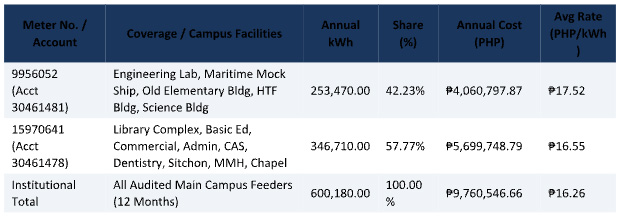
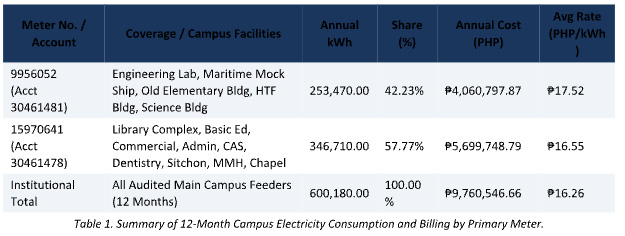
The program was conducted at Misamis University’s main campus on H.T. Feliciano Street, Ozamiz City, Misamis Occidental, Philippines (8°09?02?N, 123°50?25?E). The campus-wide review covered two primary distribution accounts: Account 30461481, Meter No. 9956052, serving the Engineering Laboratories, Maritime Mock Ship, Old Elementary Building, HTF Building, and Science Building; and Account 30461478, Meter No. 15970641, serving the Library Complex, Basic Education, Commercial Building, Administration Building, College of Arts and Sciences, Dentistry, Sitchon Building, MMH, Bookstore, MIS, University Canteen, Function Hall, and Chapel. The targeted building audit focused on the College of Engineering and Technology, particularly the Sitchon Annex classrooms SA 101–SA 109 and Sitchon Building classrooms S105, S201, S203, S204, S205, and S206.
The initiative responds to the high cooling demands associated with the Philippines’ tropical climate. High temperatures and humidity make indoor cooling important for learning and working conditions, while air-conditioning systems can account for a substantial share of institutional electricity use. As equipment ages, factors such as dirty heat exchangers, refrigerant loss, mechanical wear, and component deterioration can reduce performance and increase power consumption. Before the assessment, cooling systems across university facilities were generally serviced reactively, without quantified efficiency measurements or a detailed analysis of separate utility feeders. Misamis University therefore established a two-part review framework to connect campus-level billing data with equipment-level engineering measurements and support evidence-based energy management.
The program’s objectives were to assess electricity consumption and costs across the primary campus meters; survey cooling equipment in the College of Engineering and Technology; record electrical and environmental operating conditions; calculate the field performance of air- conditioning units; compare measured results with manufacturer specifications; and develop financially assessed retrofit recommendations for inefficient equipment. The review also sought to estimate potential energy savings, cost avoidance, and reductions in carbon emissions.
The assessment was carried out through collaboration among the Physical Plant and Maintenance Office, the College of Engineering and Technology, the Department of Electrical Engineering, and engineering researchers. Its five-phase methodology began with inspections of 18 engineering rooms and the preparation of an equipment register documenting unit details, electrical connections, and nameplate specifications. During the measurement phase, the team recorded voltage, current, and power factor hourly on weekdays, alongside indoor temperature and humidity. Saturday measurements were used to assess cooling performance during unoccupied periods and reduce the effects of people and frequent door openings on thermal readings.
In the computation phase, the team used electrical and thermodynamic measurements to estimate power input, daily energy consumption, coefficient of performance (COP), and energy efficiency ratio (EER). These field results were then compared with manufacturer-rated values to calculate performance deviations. For analysis, units were classified as efficient when deviation was no more than 5%, moderately efficient at 6% to 15%, and inefficient when deviation exceeded 15%. Equipment in the inefficient category was identified as a priority for further assessment and potential replacement.
Measurement instruments included digital thermometers and hygrometers, clamp meters, multimeters, socket wattmeters, and a true-RMS power clamp meter. The instruments were cross-checked against reference equipment to confirm that readings were within specified tolerances. This process supported the reliability of the field measurements and the consistency of the assessment. The program involved three fourth-year Bachelor of Science in Electrical Engineering student researchers—Reuben John S. Baludo, Roxanne B. Talaruc, and Brent Nithael G. Cortedor—who completed the work as part of EE 415C, Research Project/Capstone Design Project. Their faculty advisers and examination committee included Engr. Murphy T. Saumat, Engr. Isidro M. Dalis Jr., Engr. Melenita M. Rupinta, and Dr. Yunalyn L. Villantes. Engr. Philips B. Ocang, campus electrical maintenance engineers, physical plant supervisors, and the university accounting department supported the assessment by facilitating access to instruments, electrical panels, and historical billing records.
The energy review was conducted through a series of structured chronological milestones from September 2025:
Phase 1: Institutional Permitting and Utility Data Compilation
Formal administrative clearance and requests for instrument checkout were submitted to the Director of Engineering Laboratories. The Accounting and Facilities Divisions compiled 12 consecutive months of official electricity bills (September 2025 to August 2026) for Account Nos. 30461481 and 30461478. The corresponding power lines were also mapped to their respective campus buildings and facilities.
Phase 2: Laboratory Instrument Verification and Calibration Testing
All measuring instruments underwent pre-audit verification to establish measurement reliability. Voltage readings obtained using the Ingco True RMS digital multimeter (DMM) were cross- checked against those from a digital socket wattmeter, yielding readings of 225.6 V and 226.3 V, respectively, with a reported deviation of approximately 0.3%. Clamp ammeters were evaluated using controlled resistive loads and compared against reference wattmeter measurements. The recorded readings were 0.180 A and 0.209 A, respectively. The resulting percentage deviation should be recalculated and verified.
Digital hygrometers were also benchmarked against a Weksler sling psychrometer, with recorded temperature readings of 72°F (22.2°C), 22.3°C, and 21.9°C. These comparative measurements were used to assess the reliability of the instruments before field deployment.
Phase 3: Campus Walkthrough Survey and Unit Identification
Auditors conducted a physical inventory of 18 rooms across the identified campus buildings. In Sitchon Annex, nine classrooms (SA 101 to SA 109) were surveyed, identifying 17 operational Hitachi 2.0 HP window-type air-conditioning units (Model RA-20MA). These units were connected through individual 230 V receptacles. SA 105 had one unit, while each of the remaining classrooms had two units.
In Sitchon Building, seven rooms (S105 and S201–S206) were surveyed, identifying 14 operational split-type air-conditioning units. These included two Daikin 2.0 HP units in S105 and 12 Panasonic units distributed across S201 and S203–S206. Room S202 contained two non- operational units undergoing maintenance.
Phase 4: Field Electrical and Environmental Data Logging
During regular academic weekdays, voltage, current, and power factor readings were recorded hourly from 8:00 AM to 5:00 PM. On consecutive Saturdays, when the campus had limited occupancy, controlled thermal performance testing was conducted to measure ambient temperature pull-down rates. Dry-bulb temperature and relative humidity readings were recorded at the following intervals: 7:30 AM (baseline), 9:00 AM, 10:00 AM, 11:00 AM, and 12:00 PM.
Phase 5: Computational Modeling, Performance Deviation Analysis, and ECM Formulation
Active power consumption, daily energy consumption (kWh), coefficient of performance (COP), and practical energy efficiency ratio (EER) were calculated for all 31 operational air-conditioning units. Percentage deviations from manufacturer-rated specifications were also determined to assess actual operating performance relative to rated values. Based on the findings, an Energy Conservation Measure (ECM) was developed to replace the 17 existing window-type units in Sitchon Annex with high-efficiency 2.0 HP inverter split-type units (Panasonic CS/CU-XU18XKQ). The assessment included estimates of the required capital investment, projected electricity consumption, and potential operating cost savings.
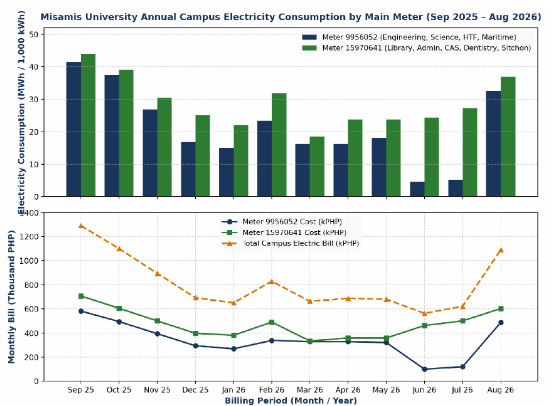
Seasonal billing patterns showed pronounced peaks during periods of intensive instruction, reaching 85,260 kWh (PHP 1,289,867.64) in September 2025 and 76,440 kWh (PHP 1,099,417.10) in October 2025. Significant dips occurred during academic recesses and semester transitions in December 2025 (41,790 kWh; PHP 692,312.09), January 2026 (36,960 kWh; PHP 650,367.24), and June 2026 (28,980 kWh; PHP 562,929.61). The data confirm that instructional cooling loads are the primary driver of monthly utility-bill spikes.
2. Technical Energy Audit Results for the Engineering Building
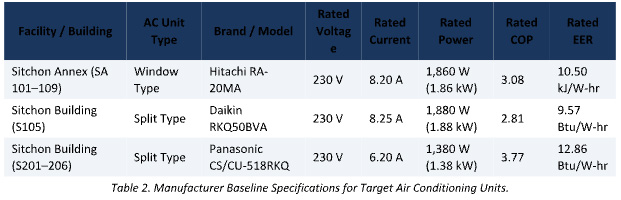
The technical audit evaluated 31 operational air-conditioning units across the College of Engineering and Technology complex. The baseline manufacturer specifications are summarized below:
Field measurements and thermodynamic efficiency calculations revealed a stark disparity between the two building types:
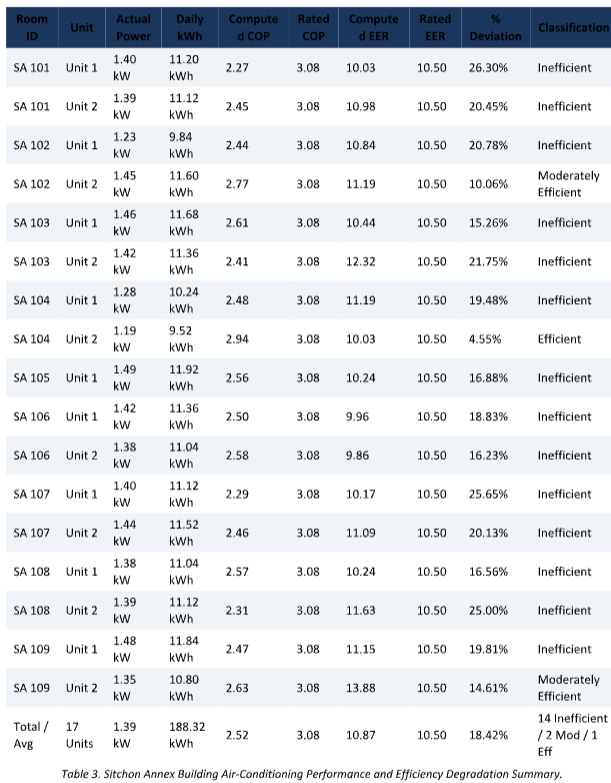
Sitchon Annex Building (window-type units): The 17 Hitachi window-type units consumed a total of 188.32 kWh/day, averaging 11.08 kWh per unit per day. Thermodynamic tolerance analysis classified 14 of the 17 units (82.35%) as inefficient, with performance deviations exceeding the 15% threshold. Deviations reached 26.30% in SA 101 and 25.65% in SA 107. Two units (11.76%) were classified as moderately efficient (6–15% deviation), while one unit (5.88%) was classified as efficient (?5% deviation).
Sitchon Building (split-type units): The split-type units demonstrated substantially better thermodynamic and electrical performance. The 12 operational Panasonic units in S201–S206 consumed a total of 92.92 kWh/day, while the two Daikin units in S105 consumed 13.84 kWh/day, bringing the building’s total cooling demand to 106.76 kWh/day. Of the 14 units assessed, six (42.86%) were classified as efficient (?5% deviation), five (35.71%) as moderately efficient (6–15% deviation), and three (21.43%) as inefficient.
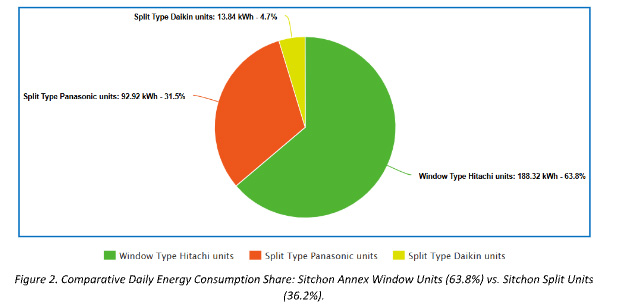
The comparative pie chart in Figure 2 shows that Sitchon Annex accounts for 63.8% of the engineering complex’s total cooling demand (188.32 kWh/day), despite serving standard instructional classrooms. By comparison, the split-type systems in Sitchon Building account for 36.2% of the demand: 92.92 kWh/day for the Panasonic units and 13.84 kWh/day for the Daikin units. These results identify the Sitchon Annex window units as the institution’s primary energy- wastage hotspot.
3. Energy Conservation Measure (ECM) and Capital Retrofit Plan
To address this energy wastage, the engineering team developed a comprehensive Energy Conservation Measure (ECM) involving the replacement of all 17 outdated Hitachi window-type units in Sitchon Annex with modern, high-efficiency inverter split-type units (Panasonic Model CS/CU-XU18XKQ; 2.0 HP; rated power input: 1,260 W; R32 refrigerant).
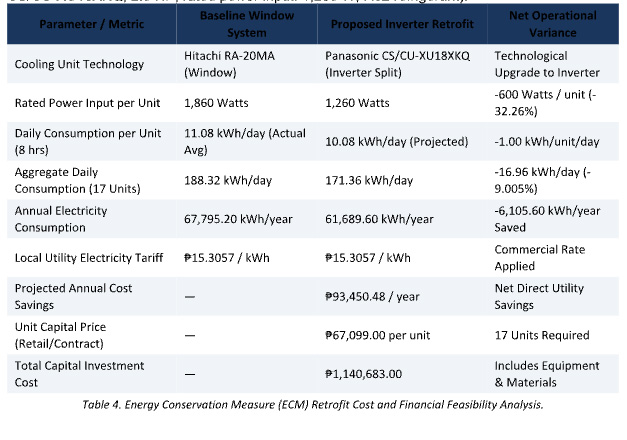
The financial and engineering analyses indicate that retrofitting the 17 window-type units in Sitchon Annex could reduce daily cooling energy consumption by 16.96 kWh (a 9.005% reduction in the building’s cooling load). This would amount to annual electricity savings of 6,105.60 kWh and recurring annual cost savings of PHP 93,450.48. In addition to reducing energy use, the retrofit is expected to lessen noise from vibrating window-unit compressors, help prevent air leakage through the building envelope, improve indoor air quality through nanoe™ X filtration, and reduce the university’s indirect carbon emissions.
Outcomes and Impact on Access to Basic Services
The institutional energy review program has produced measurable benefits for university operations, environmental stewardship, and academic development:
1. Institutionalization of SDG 7.2.5 energy-review protocols: Misamis University has
established a mechanism for auditing campus facilities. This review supports a shift from ad
hoc facilities management toward systematic, data-informed energy governance aligned
with sustainable-development goals.
2. Evidence-based capital-budget allocation: The audit identified Sitchon Annex as a major
source of energy demand within the engineering facilities. Its findings give the Board of
Trustees and university administration technical data to inform decisions about inverter
retrofits, rather than relying solely on piecemeal repairs to aging window units.
3. Predictive-maintenance protocols: In response to the audit findings, the Physical Plant
Office has shifted its maintenance approach toward scheduled and condition-based
servicing. Planned activities include bi-monthly coil cleaning, refrigerant-pressure
diagnostics, power-factor correction, and annual tracking of coefficient-of-performance
(COP) changes.
4. Potential to scale campus-wide audits: The five-phase engineering
methodology—inspection, measurement, computation, comparison, and analysis—is being
applied to other high-consumption university facilities, including the Administration Building,
Science Complex, and University Library.
5. Greenhouse-gas mitigation: The projected reduction of 6,105.60 kWh per year in Sitchon
Annex would reduce the university’s reliance on grid electricity and its associated indirect
emissions. This supports Misamis University’s efforts in climate action and sustainable
campus development.

Announcement

|

|

|
Photo Gallery
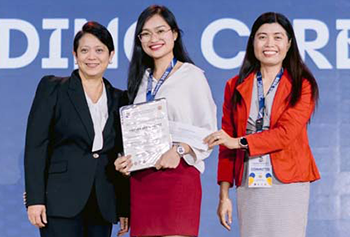 International Conference on Social Sciences 2026 |
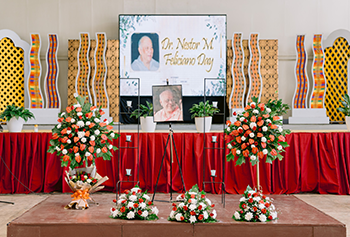 DR. NESTOR M. FELICIANO DAY |
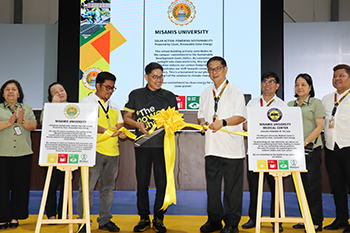 Turnover of solar energy management from WEGEN to MU |
Videos

|

|
|