 Linkage & Networking
 November 12, 2026 1:40 P.M.
 29
Misamis University’s Contribution to the Local Arts and Cultural Life of the Community
Misamis University contributes to local arts and cultural life through performances, festivals, film showings, and educational programs held throughout the year. These activities give students and community members opportunities to experience music, dance, theatre, and cultural traditions while promoting Filipino heritage, local identity, and international understanding. Among the university’s initiatives are University Chorale concerts, cultural dance competitions, campus festivals, and participation in community celebrations.
Misamis University Chorale Celebrates Bisaya, Folk, and OPM Songs in Public Concert
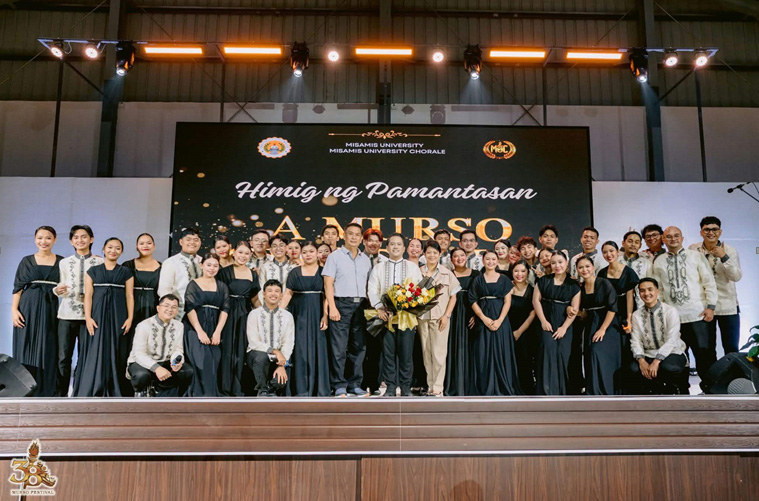
The Misamis University Chorale presented Himig ng Pamantasan: A MURSO Chorale Showcase on March 20, 2026, at 4:00 p.m. at the Hilarion T. Feliciano Activity Center on the university campus in Ozamiz City. The chorale is composed of students from different colleges at Misamis University. The concert was part of the university’s Misamis University Recognized Student Organization (MURSO) activities and was attended by more than 1,000 guests, students, faculty, and staff. The program featured Bisaya and Filipino folk songs, followed by Original Pilipino Music (OPM) selections. English-language songs popular with students were performed during the finale.
Featured Bisaya songs included “Padayon” and “Matud Nila,” written by Ben Zubiri and arranged by Ed Parungao. OPM selections included “Gaano Ko Ikaw Kamahal,” composed by Ernani J. Cuenco with lyrics by Levi Celerio; “Bukas Na Lang Kita Mamahalin,” composed by Jimmy Borja and popularized by Lani Misalucha, arranged by Ily Matthew Maniano; “Pasigin,” arranged by Eudenice Palaruan; “Anak,” written by Freddie Aguilar and arranged by Robert Delgado; and “Bituing Walang Ningning,” composed by Willy Cruz and arranged by Robert Delgado. The English-language finale included “Africa.” The concert celebrated Bisaya, folk, and OPM songs that hold a special place in Filipino culture. Through themes of community, family, love, dreams, and hope for the future, the songs offered the audience a chance to revisit shared memories and values and to celebrate Filipino identity.
Misamis University Wins Major Awards at Perangat Festival
Misamis University sent student performers to the Perangat Festival in Ozamiz City, an annual cultural dance competition held on July 16, 2026, at the Ozamiz City Hall Grounds as part of the city’s 78th Charter Day celebration. The competition showcases the beliefs, rituals, and practices of the Subanen people, an Indigenous cultural minority in Ozamiz City and the region.
Perangat is described as a Subanen word meaning “progress.” Ozamiz City has adopted it as the festival’s theme to highlight the city’s aspirations and bring its diverse communities together. The festival dance portrays aspects of Subanen life and traditions, including birth, harvest, livelihood, celebration, and death. Subanen representatives also participate in the competition as members of the competing groups. At the competition, Misamis University’s performers were awarded champions of the Ritual Showdown. They also won Best in Street Dancing, Best in Costume, and Best in Musicality. In addition, they received the Philippine Festivals People’s Choice Award, recognizing their strong public support. Ms. Arriane Zen S. Clarin placed first runner-up in the Perangat Ozamiz Festival Queen 2026 competition.
Misamis University participated in collaboration with several barangays of Ozamiz City: Aguada, Carangan, 50th District, and Molicay. Misamis University’s active participation in the 2026 Perangat Dance Festival in Ozamiz City reflects its longstanding commitment to cultural activities both within the University and throughout the local community. The University’s annual participation also demonstrates its appreciation of cultural diversity, particularly the traditions of the Subanen people, who live in the city and the region.
Preparing for the competition gives the performers an opportunity to learn about and appreciate Subanen beliefs, culture, rituals, and practices. Through the dance, they share what they have learned with the audience, helping spectators better understand Subanen traditions and the community. The participation of Subanen representatives also helps give them a voice and promotes cultural empowerment. By bringing performers, Subanen representatives, and audiences together, the festival fosters mutual understanding and respectful relationships. In this way, Misamis University’s participation supports the cultural appreciation and community harmony reflected in Perangat’s theme of progress for Ozamiz City.
Misamis University Holds Literary Competitions as Part of MURSO Cultural Festival
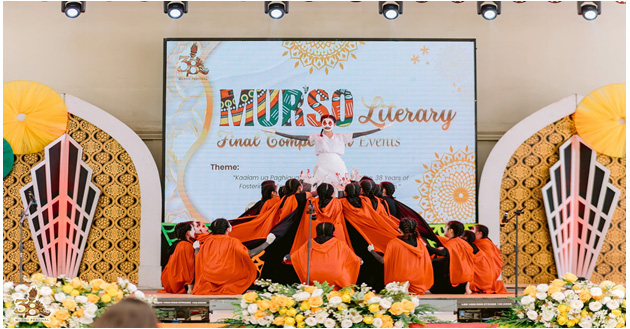
Misamis University held its literary competitions on March 24, 2026, on campus as part of the 35th MURSO Cultural Festival. Recognized student organizations took part in the competitions. MURSO stands for Misamis University Recognized Student Organizations. These student organizations are facilitated by the university’s Department of Student Affairs, which reviews applications and grants organizations official recognition on campus. They bring together students with shared interests or academic backgrounds. For example, students interested in electrical engineering may join a related organization, while Medical Technology students may join an organization connected to their field of study. These groups are collectively known as Misamis University Recognized Student Organizations (MURSO). During the MURSO celebration on March 24, the literary competition featured three categories: speech choir, balak, and impersonation. Balak is a Bisaya word for “poem.” In this category, contestants recite poems in Bisaya.
The three categories give students opportunities to express themselves. Through speech choir, students present ideas collectively. In balak, they can share personal feelings and experiences involving their peers, student life, hopes, and family relationships. The poems may reflect the circumstances they face. Impersonation also allows students to portray other people and express ideas and feelings connected to their own experiences. Together, the performances offer a glimpse into students’ lives and concerns. In the speech choir competition, Nightingale Student Circle, which is composed of Nursing and Radiologic Technology students, placed first. The Misamis University Society of Clinical Laboratory Scientists, composed of Medical Technology students, placed second, while MENTORS, composed of Education students, placed third. In the balak category, Nightingale Student Circle placed first. Nautical Odyssey Allegiance, composed of Marine Transportation students, placed second, and the Marine Engineering Technological Association, composed of Marine Engineering students, placed third.
In the impersonation category, MENTORS placed first. Hoteliers of Tomorrow, composed of Hospitality Management students, placed second, while Nightingale Student Circle placed third. The three categories provide students with ways to express their culture and reflect on life at the university, including their choices, behaviors, challenges, experiences, and aspirations. Balak, in particular, is a poetic form through which students express their ideas, feelings, and thoughts, including their successes, hopes, and frustrations. The other two categories also offer opportunities for students to share their perspectives and experiences. Together, these activities give students a platform to speak in their own voices.
By giving students this opportunity, Misamis University supports their self-expression and recognizes their opinions and beliefs about their current circumstances. The literary competition is a participatory activity and a form of empowerment: audience members hear students’ perspectives, listen to their experiences, and gain a better understanding of them. The literary competition empowers students and promotes their well-being, while also contributing to the university community as a whole.
Misamis University Celebrates Culture at “Pasigarbo sa MU: The Cultural Showdown”
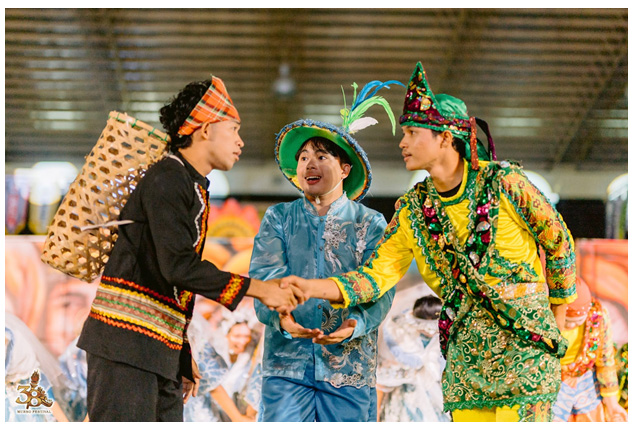
As part of its 35th Misamis University Recognized Student Organizations (MURSO) Festival, Misamis University held “Pasigarbo sa MU: The Cultural Showdown of Philippine Festivals” on March 24, 2026, at the MU Covered Court. The event featured two competitions: The Modern Ethnic Dance Competition and the Folk Dance Competition. MURSO comprises student organizations recognized by the University and coordinated through the Department of Student Affairs. These organizations are formed around students’ interests and fields of study, including hospitality, clinical laboratory science, business, etc. MURSO’s celebration highlighted student life and culture, with the cultural showdown as one of its main events. In the Modern Ethnic Dance Competition, the Nightingale Student Circle, made up of Nursing and Radiologic Technology students, took first place for its presentation of the Rosquillos Festival of Liloan, Cebu. The Misamis University Society of Clinical Laboratory Scientists, made up of Medical Technology students, placed second with its presentation of the Megayon Festival of Zamboanga del Sur. The Protectors Guild, representing Criminology students, took third place with its presentation of the Hudyaka sa Bais Festival of Bais City, Negros Oriental. The Nautical Odyssey Allegiance, representing Maritime Education students, placed fourth with its presentation of the Diyandi Festival of Iligan City, Lanao del Norte.
In the Folk Dance Competition, the Institute of Integrated Electrical Engineers, composed of engineering students, was declared the champion. The Philippine Institute of Civil Engineers, also composed of engineering students, placed first runner-up. The Society of Misamis University Dental Clinicians, representing Dentistry students, placed second runner-up, while Mentors, representing Education students, placed third. Misamis University devotes a great deal of time to promoting culture in the MURSO celebration. The cultural presentations at the Pasigarbo events showcase the traditions of various ethnic groups from across the Philippines. Through these events, the University celebrates the country’s diverse traditional dances and helps educate students and the wider community about different ethnic groups and their cultures. In doing so, the celebration fosters unity and strengthens harmony among the Philippines’ minority and majority cultural groups. Misamis University takes the lead in promoting cultural understanding and harmony among the country’s diverse peoples.
Misamis University Holds Lantern Parade as Part of MURSO Cultural Celebration
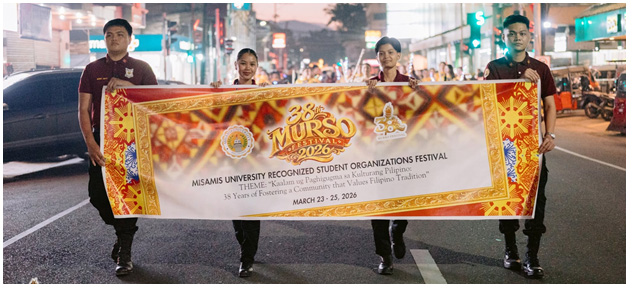
Misamis University held a lantern parade on March 23, 2026, as part of the As part of its 35th Misamis University Recognized Student Organizations (MURSO) Festival, Misamis University held “Pasigarbo sa MU: The Cultural Showdown of Philippine Festivals” on March 24, 2026, at the MU Covered Court.MURSO celebration. The parade featured lanterns designed by student organizations. Each organization selected a Philippine festival that inspired its lantern.
The participating organizations included Christian Brotherhood International (CBI); College Red Cross Youth (CRCY); Future Agriculturist Rehabilitators of Man’s Environment and Resources (FARMER); Hoteliers of Tomorrow (HOT); Integrated Institute of Electrical Engineers (IIEE); Junior Business Executives (JBE); Junior Philippine Institute of Accountants (JPIA); Junior Philippine Society of Mechanical Engineers (JPSME); Junior Social Workers Association, Inc. (JSWAP); Movement of Adventist—Adventist Ministry to College and University (MAS-AMICUS); MENTORS; Marine Engineering Technological Association (META); Misamis Occidental Volunteers for Environment (MOVE); Misamis University Biological Society (MUBS); Misamis University Legal Assistance Bureau and Advocacy Network (MULABAN); Misamis University League of Academic Scholars (MULAS); Misamis University Library and Information Science Society (MULISS); Misamis University Muslim Student Association (MUMSA); Misamis University Office Administration Students (MUOFADS); Misamis University Peer Facilitators (MUPF); Misamis University Psychology Sodality (MUPS); Misamis University Political Science Society (MUPSS); Misamis University Society of Clinical Laboratory Scientists (MUSCLAS); Misamis University Society of Talented and Young Language Enthusiasts (MUSTYLE); Nautical Odyssey Allegiance (NOA); Nightingale Student Circle (NSC); Philippine Institute of Civil Engineers (PICE); Philippine Society of Agricultural and Biosystems Engineers (PSABE); Philippine Society of Information Technology Students (PSITS); Protector’s Guild (PG); Purple Hood Society (PHS); and Society of Misamis University Dental Clinicians (SMUDEC).
The following are a few examples of the festivals represented in the parade: the Pinta Flores Festival of San Carlos City, represented by Hoteliers of Tomorrow (HOT); the Kadayawan Festival of Davao City, represented by Junior Business Executives (JBE); and the Pintados-Kasadyaan Festival of Leyte, represented by the Misamis University Society of Clinical Laboratory Scientists (MUSCLAS), composed of Medical Technology students. During the parade, students showcased their talent, creativity, and unity. They also expressed respect for and appreciation of the diverse cultures represented by the festivals they chose. The event gave students an opportunity to create meaningful presentations celebrating festivals from across the Philippines in a colorful and engaging way. Through these presentations, Misamis University celebrated the country’s cultural diversity and encouraged appreciation, understanding, and unity among Filipinos. By learning about the meanings and traditions behind the festivals, students deepen their understanding of one another and strengthen a sense of harmony within the region and across the Philippines.
Misamis University Concludes 35th MURSO Celebration with a Barrio Fiesta
Misamis University concluded its 35th Misamis University Recognized Student Organizations (MURSO) Cultural Celebration on March 25, 2026, with a closing ceremony and barrio fiesta. “Barrio fiesta” combines two words: barrio, a Spanish-derived word for a neighborhood or village, and fiesta, meaning a celebration or feast. Before and during Spanish rule, many Filipino communities were organized into settlements commonly called barangays. The word barangay is traditionally linked to balangay, a type of boat. Spanish authorities later used barrio for local districts or settlements, and pueblo for a town or municipality made up of smaller communities. In many Filipino communities, people have family ties on both their mother’s and father’s sides. A barrio fiesta brings relatives, neighbors, and friends together to share food and celebrate. It reflects the close family and community bonds that make the gathering feel like an extended family meal.
Dating back to the colonial period, communities that had adopted Christianity celebrated feast days in honor of their barrio’s patron saint. Families prepared banquets and invited extended relatives, including both blood relatives and people considered family, as well as friends. These celebrations, known as fiestas, bring families and community members together to share food and celebrate. To conclude the 35th MURSO Cultural Celebration, students from the university’s colleges and student organizations gathered for a barrio fiesta in an open, green space on campus. The event began at around 6:00 p.m. Participants brought Filipino dishes and delicacies to share. Lechon was one of the main dishes served, and students enjoyed the food together over dinner. At the end of MURSO, students laughed, danced to disco music, and shared a meal, bringing the celebration to a joyful close. Their gathering echoed the sense of togetherness associated with a barrio fiesta. Through this event, Misamis University celebrated a Filipino cultural tradition that can help build and strengthen unity. The celebration encouraged students to connect with one another and fostered a sense of community and harmony. It also highlighted the university’s connection with the wider Ozamiz City community.
Misamis University Celebrates the Sinulog Festival
Misamis University celebrated the Sinulog Festival on January 26, 2026, at the MU Covered Court on its campus in Ozamiz City. The festival honors the Santo Niño (Holy Child Jesus), whose image is venerated by Catholics in the Philippines. The Sinulog Festival is most associated with Cebu, where the celebration commemorates the introduction of Christianity in 1521. Historical accounts state that Portuguese explorer Ferdinand Magellan presented an image of the Santo Niño to Rajah Humabon and his wife. The couple and many of their subjects were subsequently baptized into the Catholic faith. Participants in the Sinulog celebration of the university included staff, faculty, and students from Basic Education; the College of Computer Studies; the College of Business and Management; the College of Maritime Education; the College of Criminology; the College of Arts and Sciences; the College of Dentistry; and the College of Medical Technology; and the College of Nursing and Radiologic Technology. The celebration began with a procession carrying the image of the Santo Niño from the cathedral to the university campus and then to the covered court. Students, staff, and faculty joined the procession on campus before proceeding to the Eucharistic celebration at the covered court. Rev. Fr. MJ Mark Julius Samonte of the Archdiocese of Ozamiz presided over the Mass.
In his homily, Fr. Samonte emphasized the humility exemplified by a child, Santo Niño. He reminded the congregation to practice humility and uphold Christian values. He also said that embracing these lessons can help guide people through life with a lighter heart, free from unnecessary burdens and worries. During the Mass, Rev. Fr. Samonte led the congregation in the acclamation, “Viva! Pit Señor!” Viva is Spanish for “Long live!” Pit Señor is commonly understood as a shortened form of “Sangpit sa Señor,” meaning “Call upon the Lord.” The acclamation expresses devotion to the Santo Niño. After the Mass, the participants performed the Sinulog dance. In Cebu and in many Catholic communities, devotees dance in front of the image of the Santo Niño as an expression of their faith and devotion. Through the dance, they may offer prayers and petitions, asking the Santo Niño for help and guidance.
Regardless of whether they receive a tangible result, the dance remains an important part of the faith and devotional practice of many believers and devotees. It provides them with a way to express their Catholic faith and devotion to the Santo Niño. Through this activity, Misamis University provided a space for believers to express their faith and cultural traditions. By allowing participants to join freely, the University demonstrated respect for religious freedom and its openness to people of different beliefs. This practice helps students, staff, and faculty feel welcome and supported in expressing their religious and cultural identities.
Misamis University Hosts Film Viewing on Filipina Hero Gregoria de Jesus
Misamis University held a film viewing about Filipino heroine Gregoria de Jesus for students from the 11 colleges and Basic Education Departments, as well as for its staff and faculty. The viewing took place from September 3 to 5, 2026, at the Hilarion T. Feliciano Activity Center on the university campus in Ozamiz City. This independent film, produced by Ellen Marfil, was presented at the university and screened for students, staff, and faculty. It tells the story of Gregoria de Jesus, wife of Andres Bonifacio, a revolutionary leader during the Philippine Revolution against Spanish rule. De Jesus played an important role in the revolution, safeguarding letters and other vital documents belonging to the Katipunan, the secret revolutionary organization. Her roles as a daughter, wife, mother, and grandmother are portrayed in the film. As a daughter, she follows her heart. As a wife, she supports and advises her husband, Andres. His loss brings her great sorrow, but she perseveres as a mother and remains resilient into old age. The film takes a feminist approach, highlighting women’s roles and value through the story of a Filipina heroine who contributed to the birth of the Filipino nation in the late 19th century. It portrays her roles, sacrifices, and struggles in both her personal life and public service, allowing viewers to hear her voice and understand her story.
The film viewing was facilitated by Lea L. Espaliero, a UNESCO-accredited facilitator and feminist advocate. Iya Oliva assisted with documenting the activity. Michael Chua, one of the film’s consultants, was also featured in it. After the first day’s screening, an open forum gave viewers the opportunity to share their perspectives. Participants offered thoughtful and enlightening insights that deepened their understanding of the film’s message. Mr. Mark K. Jumawan of the Basic Education Department asked whose perspective the film was based on. He remarked, “History is written by the victors.” Mr. Yolando P. Edulantes of the College of Business Management said the film moved him and made him feel sad. Dr. Lloyd Ranises, Director of Linkages and International Affairs, emphasized the film’s feminist perspective. He quoted Gregoria de Jesus as saying, “The role of women is peacekeeping.”
Ms. Johanna Marie R. Balais of the College of Nursing, Midwifery, and Radiologic Technology spoke about the bodily experiences of patients she encounters in her work as a clinical instructor and nurse. She highlighted the trauma Oriang (Gregoria de Jesus’s nickname) experienced when she was unable to see her husband’s body after his death. Mr. Erwin C. Cubillan, also of the College of Nursing, Midwifery, and Radiologic Technology, likewise focused on bodily experiences. He discussed the mental distress Gregoria de Jesus may have experienced following the tragic and painful loss of her husband, Andres. Mrs. Eden Neri, the University Guidance Coordinator, reflected on Filipino cultural attitudes that place men above women. She said, “I felt a little angry when Andres Bonifacio did not heed Lakambini’s warning about the Katipunan meeting or election, because her intuition told her it was a trap. Lakambini’s concern for Andres and her efforts to protect the organization were brushed aside.” Mrs. Neri noted that the scene reflected how women’s roles were often regarded as unimportant in the past, while men’s authority was treated as superior. Ms. Louisse Lane Dumaguing, a Psychology instructor, connected Gregoria’s stress and trauma to the ongoing challenges that women may continue to experience today. She also reflected on the effects of generational stress.
Mr. Adjemore Manabat, an English instructor, focused on the story’s portrayal of human nature and the role of personal narratives in shaping how events are understood. He reflected on the film’s storytelling and emphasized how narratives give people a voice and allow others to hear their stories. Ms. Katrina Salindo, an instructor in the Natural Science Department, discussed the film’s theme of patriotism. She noted how commitment to a cause can be driven by one’s patriotic ideals. Mr. Rodel Baldado, Director of Student Affairs, was more concerned with historical clarity and discussed the divisions among the Katipuneros and the lack of unity between those in Cavite and Manila. Lastly, Ms. Chilzien Babe B. Huring of the College of Business Management emphasized the importance of women’s role in decision-making. Gregoria’s choices shaped the course of her life, she noted, so it is important to be confident and courageous in making one’s own decisions.
The film screening generated a range of themes and reflections among the audience. These responses affirmed that viewers recognized the essential role of Filipina heroes, each through their own perspective. The film broadened viewers’ horizons, allowing them to consider different lessons about women, as daughters, wives, mothers, and grandmothers. Exploring these many facets can deepen understanding and support the pursuit of gender equality. After the open forum, Ms. Espaliero called for support of a bill introduced in Congress that would require the study of Philippine history by the country’s women leaders. The audience was invited to show their support by signing through the provided link. The activity served as an exploratory lesson on understanding women’s roles in society. It grew out of an advocacy for gender equality and received a positive response from the audience. Misamis University brought the community together to learn more about women’s experiences in Philippine history, a subject that has not been explored enough. The activity offered an opportunity to examine this issue from a broader perspective and to better understand the many facets of society and the complexity of women’s roles within it. This understanding can help community members work together toward peace and development.
Misamis University Showcases Filipino and ASEAN Cultures at ASEAN+2 Celebration
Misamis University held its ASEAN+2 Day Celebration at the Hilarion T. Feliciano Activity Center on July 10, 2026, from 1:30 p.m. to 5:00 p.m. The event was part of the university’s 2026 International Exchange and Cultural Learning Program, in which international students participated. The celebration highlighted Filipino, ASEAN, and broader Asian cultures, with a particular focus on the cultures represented by the participating international students. Featured traditions included main dishes, dances, and songs from the Philippines, Thailand, and Indonesia. The event also supported the Philippines’ hosting of the 59th ASEAN anniversary celebrations this year. This program promoted unity and cultural understanding among higher education institutions (HEIs) in ASEAN member states, as well as partner institutions in Taiwan and South Korea, represented by “+2” in the event title. It strengthened engagement among partner HEIs and enhanced students’ intercultural awareness, supporting the university’s international collaboration. Participants included international students in the exchange program and Misamis University students.
The ASEAN+2 Day Celebration was a major component of the 14-day MU International Exchange and Cultural Learning Program, held from June 29 to July 11, 2026, and served as the program’s culminating activity. The international students included Aitsara Rittisakcgonladet, Narisa Musikun, Pattaratorn Nakphairat, and Usanisa Tinnnakon from Kasetsart University in Bangkok, Thailand; and Akbar Darujati Kusumo from Universitas Brawijaya in Malang, Indonesia. Students from the University’s eleven colleges and the Basic Education Department, along with the deans, faculty and staff, also participated in the celebration. In total, approximately 600 people attended. Misamis University’s partner institutions in the ASEAN region and Asia, particularly Kasetsart University in Thailand and Universitas Brawijaya in Indonesia, actively participated by sending students to attend the 2026 MU International Exchange and Cultural Learning Program and the ASEAN+2 event in person. The presidents of the partner universities were invited to deliver messages of support and to join the celebration. In the program, Dr. Karen Belina F. De Leon, University President, delivered the welcome address. This was followed by recorded messages from Dr. Ok-Hyun Yoon, President of Gimcheon University in South Korea; Dr. Christine Nabor Ferrer, Chief of the CHED International Affairs Service at the Central Office; and H.E. Millicent Cruz Paredes, Philippine Ambassador to the Kingdom of Thailand. Cultural performances followed the messages. MU dancers performed the Cariñosa, a traditional Filipino folk dance. A video presentation featuring a Chinese dance by Gimcheon University came next. Akbar Darujati Kusumo, together with a group of MU students, then performed an Indonesian dance, followed by a Thai dance performed by four Thai students: Aitsara, Narisa, Pattaatorn, and Usanisa.
This was followed by a performance by the MU Chorale of Rosas Pandan, a popular Bisaya song known in the Philippines and abroad. University choirs in other countries have also performed the song. Another series of recorded messages from university presidents and foreign dignitaries followed. These included a message from Dr. Berlilana, M.Kom., M.Si., Rector of Universitas Amikom Purwokerto in Purwokerto, Indonesia, and H.E. Victorina Hesti Dewayani, Chargé d’Affaires a.i. at the Embassy of the Republic of Indonesia in Manila. Another cultural presentation followed, with MU dancers performing the Subanen dance for the second time. Next, a video featured Indonesian, Thai, and Filipino dishes prepared by Indonesian, Thai, and MU students. The MU Chorale then sang Paru-parong Bukid, another popular Filipino folk song. The final round of messages from university presidents and foreign dignitaries followed. Speakers included Prof. Widodo, S.Si., M.Si., Ph.D., Med.Sc., Rector of Universitas Brawijaya in Malang, Indonesia, and H.E. Evangeline T. Ong Jimenez-Ducrocq, Permanent Representative of the Philippines to the Association of Southeast Asian Nations (ASEAN) in Jakarta, Indonesia. To conclude the celebration, participants joined the Interactive Unity Dance, which featured simple Filipino dance steps and invited everyone to take part. The MU Chorale sang Piliin Mo ang Pilipinas (“Choose the Philippines”), and all participants danced to the song. Its message encouraged foreigners to visit the Philippines and inspired Filipinos to feel greater patriotism. This was followed by a presentation of the 14-day activities of the MU International Exchange and Cultural Learning Program 2026.
Dr. Lloyd B. Ranises, Director of Linkages and International Affairs, closed the program by thanking the university partners and everyone who contributed to the event’s success. Through this activity, Misamis University strengthened its commitment to cultural exchange and learning. The program celebrated Filipino culture through food, songs, and dances, using these shared experiences to foster unity and harmony. It also extended that sense of connection beyond the Filipino community by bringing together participants from neighboring ASEAN and other Asian countries. The activity strengthened partnerships among universities and enriched students’ experiences and learning programs, promoting unity and harmony across borders. ?
Misamis University Showcases Filipino Culture Through Its International Exchange and Cultural Learning Program
Misamis University, through the Office of Linkages and International Affairs, hosted online and on-site cultural exchanges through its MU International Exchange and Cultural Learning Program, held from June 29 to July 11, 2026. The program focused primarily on Filipino culture, including Philippine history and values, Filipino cuisine, folk dances, and heritage. It aimed to deepen students’ understanding and appreciation of different cultures through effective communication, while promoting harmony and unity among participants from various countries. Misamis University welcomed foreign students Aitsara Rittisakcgonladet, Narisa Musikun, Pattaratorn Nakphairat, and Usanisa Tinnnakon from Kasetsart University in Bangkok, Thailand, and Akbar Darujati Kusumo from Universitas Brawijaya in Malang, Indonesia. The program was divided into two parts. The first, held online from June 29 to July 2, 2026, featured lectures. This was followed by on-site activities from July 6 to 11, 2026. During the 14-day exchange program, the online first week featured lectures on topics such as Philippine history and values, Filipino cuisine, folk dances, and heritage.
During the on-site second week, participants took part in Bisaya language drills and visited several local tourist attractions, including Jimenez Old Church and Asenso Misamis Occidental Resort and Aquamarine Park (AMORAP). They also visited the Oroquieta Capitol Building, where they observed legislative proceedings in the legislative hall, and the House of Suman in Clarin, where they learned about the product-making process. At Paglinawan Farm, they explored innovative agricultural practices and beverage production. During the week, they also prepared Filipino and international dishes with students from the MU Hospitality Management program. The cultural exchange program culminated in an ASEAN+2 celebration on July 10. The foreign students returned home safely on July 12, 2026.
Through this activity, Misamis University demonstrated its commitment to promoting the understanding and appreciation of Filipino culture while also encouraging the community to learn about Thai and Indonesian cultures. The program brought students and members of the wider university community together to understand and appreciate one another. It broadened participants’ cultural perspectives and helped them gain a better understanding of their regional neighbors. Ultimately, the program fostered community unity and strengthened bonds of friendship and harmony with ASEAN and other Asian partners, contributing to a more united and peaceful world.

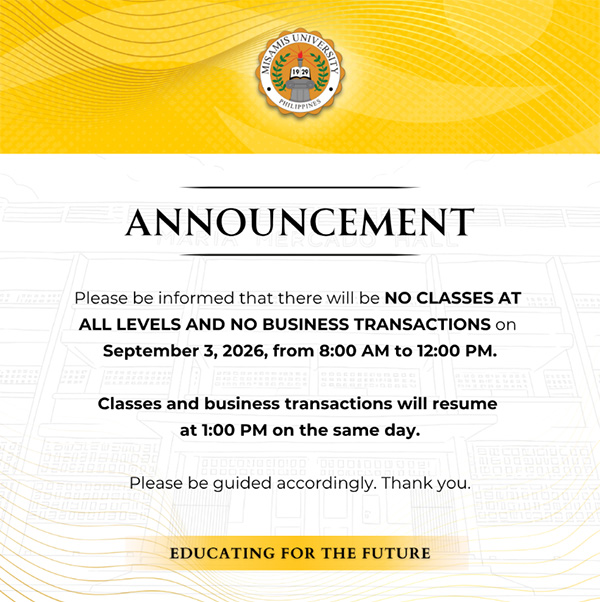
Announcement
|
|
|
Photo Gallery
 International Conference on Social Sciences 2026 |
 DR. NESTOR M. FELICIANO DAY |
 Turnover of solar energy management from WEGEN to MU |
Videos

|

|

|