

 31
Misamis University Verifies Campus Solar Generation and Low-Carbon Energy Offsets
Misamis University launched a campus-wide solar photovoltaic (PV) performance and verification program to measure renewable electricity generation and its contribution to institutional energy use. The initiative supports reporting under UN Sustainable Development Goal 7 (SDG 7), including Indicator 7.5.2 on energy used from low-carbon sources.
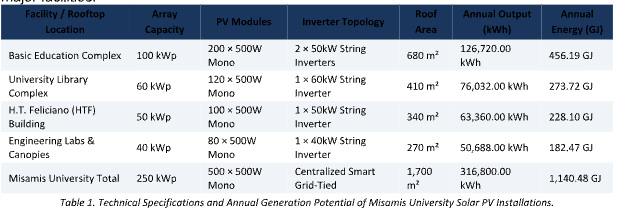
The program evaluates a reported 250-kilowatt-peak (kWp) of rooftop solar installations across four campus locations: the Basic Education Complex (100 kWp), the University Library Complex (60 kWp), the H.T. Feliciano Building (50 kWp), and the Engineering Workshops and Canopies (40 kWp). Together, the arrays cover an estimated 1,700 square metres.
Monitoring combined an intensive verification period from September to October 2025 with a 12- month renewable-generation cycle from September 2025 through August 2026. Annual data were consolidated in October 2026. The project used inverter monitoring and smart power meters to track solar output, grid imports, and on-site electricity use during campus operations.
The verification process included inspections of PV modules and inverter connections, collection of real-time telemetry, and comparison of solar production with utility-meter readings. The team also converted electricity generation from kilowatt-hours into gigajoules using the standard conversion factor of 1 kWh to 0.0036 GJ. These measurements were intended to establish the university’s annual renewable-energy baseline, calculate solar’s share of campus consumption, and estimate utility-cost savings and avoided emissions.
The Physical Plant Office, College of Engineering and Technology, student researchers, campus engineers, and solar technicians collaborated on the program. Senior engineering students helped with data logging, inverter diagnostics, and analysis under the guidance of faculty mentors and facilities staff.
The findings are expected to inform campus energy planning and support the university’s SDG 7.5.2 reporting. By generating electricity on site, the solar installations may also reduce grid purchases and ease demand on campus electrical infrastructure during periods of strong midday cooling demand. The system provides an additional educational benefit, giving engineering students access to operational solar data for renewable-energy coursework.Results and Outputs The study established certified empirical metrics for Misamis University's renewable energy generation and low-carbon offset.
The results are the following:
1. Campus-Wide Solar Photovoltaic Installation Specifications
Misamis University operates 250 kWp of newly installed rooftop solar PV systems across four
major facilities:
2. September–October Intensive Verification Study Results
During the September and October 2025 Energy Density Study window, precision telemetry
verified exact electrical output across all solar installations, fulfilling the university's institutional
disclosure:
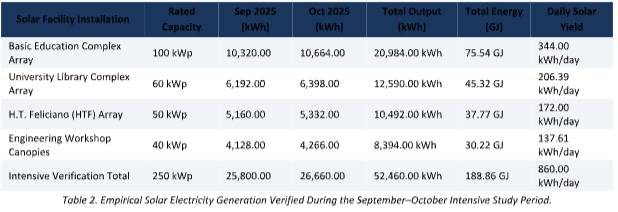
The solar facilities generated an aggregate of 52,460.00 kWh (188.86 GJ) during the 61-day intensive study period. When evaluated against the total gross campus electricity demand of 214,160.00 kWh (161,700 kWh grid import + 52,460 kWh solar self-consumption), the solar arrays directly supplied 24.50% of the university's total electricity demand during peak academic operations.
3. Official 12-Month Total Energy Used from Low-Carbon Sources (SDG 7.5.2 Baseline)
Consolidating the full 12-month operational cycle (September 2025 to August 2026) establishes
the official institutional baseline:
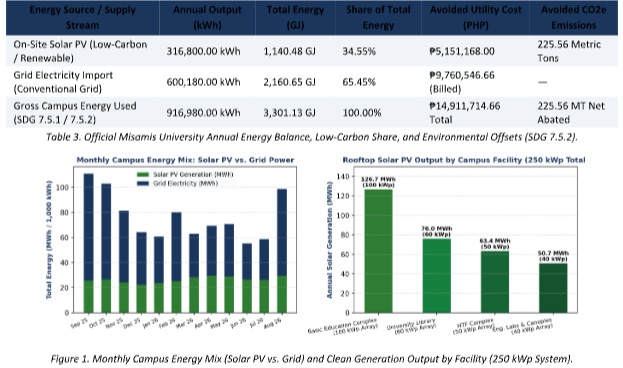
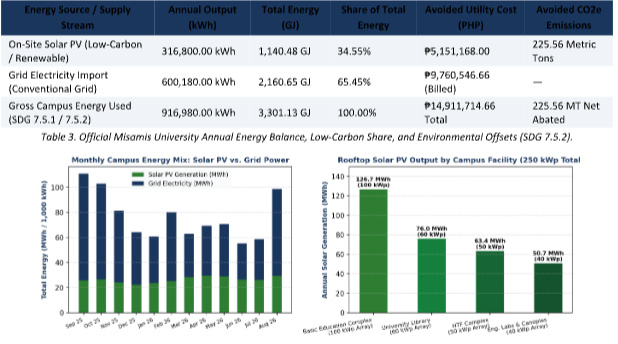
The annual monitoring cycle reported that Misamis University generated 316,800 kWh (1,140.48 GJ) of solar electricity, equivalent to 34.55% of total institutional energy consumption. Solar output peaked from 10:00 a.m. to 2:00 p.m., coinciding with periods of high air-conditioning demand and helping reduce reliance on grid electricity during peak campus operations.
The study also estimated annual utility-cost avoidance of ?5,151,168 and avoided Scope 2 emissions of 225.56 metric tons of CO? equivalent. The results provide empirical figures for the university’s SDG 7.5.2 reporting, replacing estimates with measured renewable-energy data. On-site generation may also help the university manage exposure to changing electricity tariffs and reduce demand on campus electrical infrastructure during peak hours.
Other reported institutional benefits include:
1. Operational support: Midday solar generation helps relieve demand on campus feeders and
transformers.
2. Educational use: Inverter and generation data serve as a practical resource for engineering
coursework and student research.
3. Sustainability reporting: Verified generation and emissions estimates support the
university’s broader low-carbon energy planning.

Announcement

|

|

|
Photo Gallery
 International Conference on Social Sciences 2026 |
 DR. NESTOR M. FELICIANO DAY |
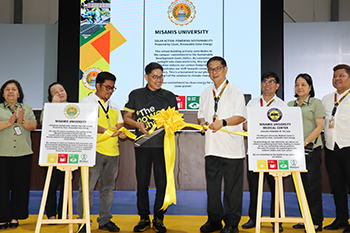 Turnover of solar energy management from WEGEN to MU |
Videos

|

|

|