

 29
Misamis University’s Efforts to Reduce Commuting and Carbon Emissions
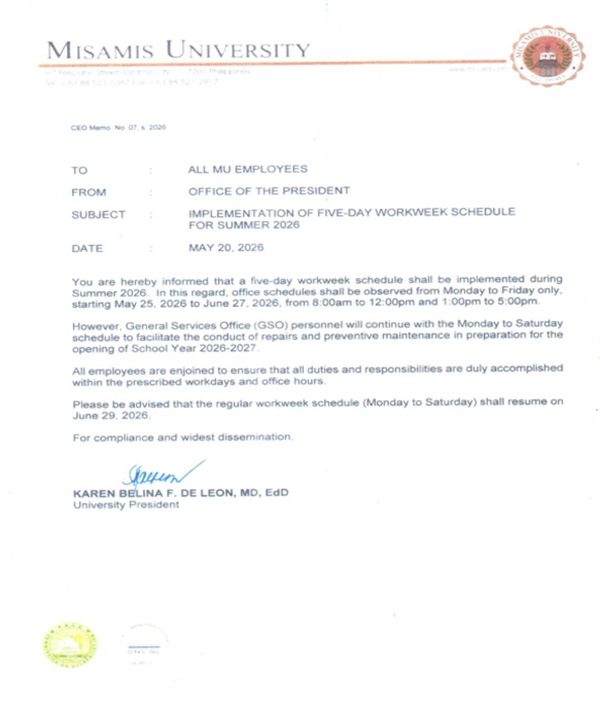
Misamis University uses online and hybrid learning formats and has introduced a five-day workweek for employees during the summer of 2026. These arrangements reduce the need for students, faculty, and staff to travel to campus for certain classes and activities. By limiting commuting, the initiatives may also help reduce carbon emissions and benefit the University community, Ozamiz City, surrounding areas, and the environment over time.
Misamis University Offers Remote Classes for Graduate and Undergraduate Students via MS Teams
Misamis University offers graduate classes online through Microsoft Teams. Most graduate classes are conducted remotely, but students are required to attend at least two on-campus meetings. The university adopted this arrangement during the pandemic and has continued it since then. It accommodates graduate students who travel from distant municipalities, cities, and provinces, as well as working professionals who need to balance their studies with their careers.
Graduate students at Misamis University come from a range of professional fields, including nursing, education, business, public service, and criminology. In the first semester of the 2026–2027 academic year, Misamis University accommodated 467 graduate students in online classes. They are 46 students in the PhD in Nursing program, 46 in the Doctor of Education program, 19 in the Doctor of Management program, 50 in the Master of Arts in Education program, 104 in the Master of Arts in Nursing program, 71 in the Master of Science in Criminal Justice program, 49 in the Master in Nursing program, 28 in the Master of Public Administration program, and 54 in the Master of Business Administration program. Misamis University’s online classes enable students to pursue advanced degrees, including master’s and doctoral programs. This approach aligns with the University’s mission of providing education for all.
Misamis University Implements Temporary Five-Day Workweek
Misamis University implemented a temporary five-day workweek from May 25 to June 27, 2026, with employees working Monday through Friday, from 8:00 a.m. to 12:00 p.m. and 1:00 p.m. to 5:00 p.m. The regular Monday-to-Saturday workweek resumed on June 29. During the temporary arrangement, offices were expected to manage their work to meet required outputs.
Although Misamis University’s announcement did not state the reason for the temporary five-day workweek, the arrangement took place amid rising oil prices and concerns about fuel supply linked to tensions involving Iran and other countries in the Middle East, including risks to shipping through the Strait of Hormuz. Reducing commuting days may have helped employees lower their transportation expenses and could have contributed modestly to fuel conservation. Thus, the policy may be viewed as a practical response to the wider economic pressures of the period.
Online Learning and a Five-Day Workweek Help Reduce Carbon Emissions
Online graduate classes help reduce carbon emissions by limiting the need for Misamis University students and employees to commute. They support effective learning when suited to the activity, particularly for students traveling from other provinces whose courses consist mainly of lectures and do not require laboratory work.
The University’s online learning systems support teaching while reducing travel-related emissions. This benefits the Misamis University community, Ozamiz City, nearby communities, and the environment over time. A five-day workweek may also benefit University employees in two ways. First, fewer commuting days could help them manage higher transportation costs associated with rising oil prices. Second, reduced commuting may contribute to fuel conservation amid concerns about the Strait of Hormuz and the wider Middle East crisis.

Announcement

|

|
|
Photo Gallery
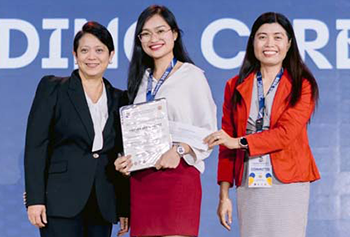 International Conference on Social Sciences 2026 |
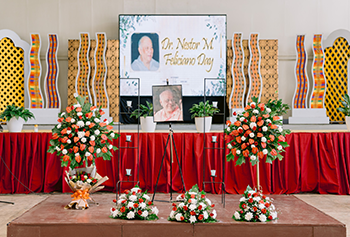 DR. NESTOR M. FELICIANO DAY |
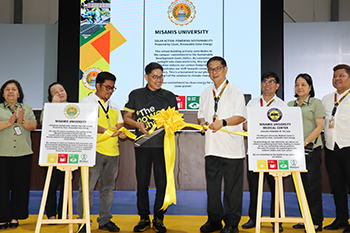 Turnover of solar energy management from WEGEN to MU |
Videos

|

|

|