

 30
Extension of Misamis University Sustainability and Waste Minimization Policies to Outsourced Suppliers and the Supply Chain (Equipment, Stationery, and Building Contracts)
Misamis University systematically extends its newly formulated responsible consumption, waste minimization, and ethical procurement policies across all outsourced goods suppliers and upstream supply chains explicitly covering vendors of ICT and electrical equipment, office and instructional stationery, furniture, construction materials, and building contractors under an ISO 21001:2018-aligned governance framework (Clause 8.4, Control of Externally Provided Processes, Products, and Services, as referenced in Section 13.1 of the Ethical and Sustainable Sourcing Policy and Section 4 of the Single-Use Plastic and Disposable Item Minimization Policies). Specifically, Section 3 (Scope / Scope and Applicability) of all five policies—the Ethical and Sustainable Sourcing of Food and Supplies Policy, Single-Use Plastic Minimization Policy, Disposable Item Use Minimization Policy, Waste Disposal Measurement and Diversion Policy, and Hazardous and Laboratory Waste Management Policy expressly binds all suppliers, manufacturers, construction contractors, lessees, and their upstream subcontractors supplying goods or executing building projects for the University.
Under Section 7.5 (Non-Food Supplies and Hazardous Materials) of the Ethical and Sustainable Sourcing Policy and Section 8.1 (Controlled Disposable Items) of the Disposable Item Use Minimization Policy, suppliers of stationery and printed materials must prioritize digital workflows, recycled content, and responsibly managed fiber (Section 7.5 [a] and Section 8.1, Paper handouts, folders, and routing materials); suppliers of ICT, appliances, and laboratory equipment must meet energy-efficiency, durability, repairability, take-back, and responsible e-waste criteria (Section 7.5 [c] and Section 8.1, Batteries, cartridges, and small accessories); and building and furniture suppliers must adhere to non-toxic, low-emission, certified, durable, and modular material standards alongside construction waste segregation (Section 7.5 [d] of the Ethical Sourcing Policy and Section 3 & Section 8.2 of the Waste Disposal Measurement and Diversion Policy). To institutionalize enforcement upon implementation, Section 7.2 (Minimum Supplier Code of Conduct), Section 7.6 (Solicitation, Evaluation, Award, and Contracting), and Annex D (Minimum Contract Clause) of the Ethical Sourcing Policy, reinforced by Section 8.3 (Procurement and Third-Party Controls) of both minimization policies, require all prospective goods and construction suppliers to sign the Supplier Ethical and Sustainability Declaration (Annex A / Form MU-EOMS-ENV-F05), undergo weighted pre-award sustainability screening (Annex B), minimize secondary packaging through consolidated and returnable delivery systems (Section 7.5 [e] and Section 8.3), and cascade equivalent environmental and ethical standards to their own subcontractors (Section 7.2 [h]). Through mandatory delivery verification (Section 7.7), scheduled supplier audits (Section 7.8), and enforceable contractual sanctions for greenwashing, falsified certifications, or noncompliance (Section 7.8 [d] and Annex D), Misamis University ensures full supply-chain accountability across all procured equipment, stationery, and infrastructure contracts.
Summary of Supporting Policy Sections & Clauses for SDG 12.2.8
Ethical and Sustainable Sourcing of Food and Supplies Policy
o Section 1 & Section 3 (Policy Statement & Scope): Explicitly extends policy
requirements to suppliers, construction contractors, and subcontractors across
office/instructional supplies, ICT/electrical equipment, furniture, construction materials,
and packaging.
o Section 7.2 (a–h) & Annex A (Minimum Supplier Code of Conduct & Declaration):
Obligates suppliers to follow fair labor, environmental, anti-greenwashing, and
subcontractor flow-down (7.2 [h]) standards.
o Section 7.5 (a–e) (Non-Food Supplies and Hazardous Materials): Establishes specific
green procurement rules for paper/stationery (7.5 [a]), ICT/equipment (7.5 [c]),
furniture/construction materials (7.5 [d]), and shipping packaging (7.5 [e]).
o Sections 7.6–7.8, Annex B & Annex D: Mandates pre-award vendor scoring (Annex B),
delivery verification (7.7), audits (7.8), and binding contract clauses (Annex D).
Disposable Item Use Minimization Policy & Single-Use Plastic Minimization Policy
o Section 3 & Section 4 (Scope & Normative Bases): Binds all suppliers, construction
contractors, and vendors under ISO 21001:2018 Clause 8.4 and RA 11898 (Extended
Producer Responsibility Act).
o Section 8.1 (Controlled Disposable Items — Disposable Item Policy): Sets strict
reduction, refill, reuse, and take-back controls for paper handouts/stationery,
folders/envelopes, batteries/cartridges, and shipping/secondary packaging.
o Section 8.3 (Procurement and Third-Party Controls) & Form MU-EOMS-ENV-
F05: Mandates vendor clauses requiring consolidated deliveries, returnable crates,
packaging disclosure, inspection rights, and subcontractor flow-down.

Announcement

|
|

|
Photo Gallery
 International Conference on Social Sciences 2026 |
 DR. NESTOR M. FELICIANO DAY |
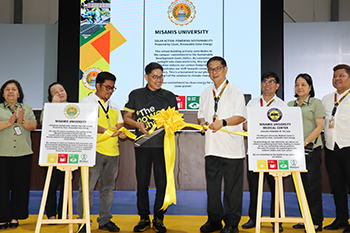 Turnover of solar energy management from WEGEN to MU |
Videos

|

|

|