

 29
Misamis University Workforce Stability, Compensation, and Benefits
Misamis University (MU) reports a 100% faculty and staff retention rate over the past four years and an average annual attrition rate of 0.05% over the past ten years. These results show workforce stability across academic and administrative functions. MU supports this outcome through compensation, benefits, and educational opportunities for employees and their dependents, while maintaining salary continuity during low-enrollment periods. Annual HR movement reports, workforce counts, payroll records, and benefit records validate these results and identify changes that require management action.
For wage workers, Misamis University’s compensation approach supports faculty and staff across regular, probationary, part-time, and contractual appointments. In determining and reviewing pay, the University considers regional wage orders, official poverty statistics, employee needs, institutional resources, and applicable labor requirements. Under Wage Order No. RX-24, effective May 1, 2026, the daily minimum wage is ?485 for Wage Category II and ?500 for Wage Category I, which includes Ozamiz City. MU provides a daily wage of ?500, equivalent to ?62.50 per hour for an eight-hour workday or ?13,000 based on 26 paid working days per month.
The University’s compensation reviews can also draw on official poverty statistics to contextualize employees’ financial needs. The Philippine Statistics Authority’s 2025 Full-Year Official Poverty Statistics, released on October 19, 2026, placed Northern Mindanao’s monthly poverty threshold at ?14,938 for a family of five. A proportional calculation for a family of four yields ?11,950.40 per month, equivalent to approximately ?57.45 per hour using the same 26- day, eight-hour basis. These calculated figures serve as supplementary comparisons; they are neither separately published PSA thresholds nor an official living-wage rate. Considered alongside household circumstances and the University’s educational, healthcare, and financial benefits, these benchmarks provide context for reviewing compensation and strengthening employee support.
For Faculty and Staff, the university’s starting monthly salaries for qualified, licensed faculty members and those with a master’s degree are comparable to the corresponding entry-level salaries in reputable educational higher institutions. The University pays salaries on schedule and processes applicable withholding tax, Social Security System, PhilHealth, and Pag-IBIG contributions, together with employee-authorized deductions and loan payments. Eligible employees receive 13th-month pay, Christmas and 13 th month, performance-based bonus and incentives, retirement benefits, PERAA, leave privileges, and other benefits under University policies. Payroll registers, contracts, payslips, remittance reports, and benefit records verify approved compensation, deductions, and exceptions.
MU further supports employees through financial, healthcare, and educational benefits within its institutional network. Two MU-owned Misamis Rural Banks offer preferential loan terms, described by the University as its lowest-interest loan options. MU Medical Center provides employee discounts and staggered payment arrangements to help employees and their families manage healthcare expenses. The University also maintains regular salary payments throughout the year, including the summer period, when enrollment typically declines to approximately 1,500–1,700 students, compared with 7,000–8,000 during regular terms. This commitment helps employees and their families meet their continuing financial needs while supporting the retention of qualified personnel and the continuity of essential university services between school years.
Employees’ children receive a 100% tuition discount from grade school through senior high school and a 70% tuition discount for college. Employees pursuing graduate studies receive a 50% tuition discount. Additional family discounts depend on the employee’s length of service and are subject to applicable benefit policies and eligibility requirements.
These benefits extend employee support beyond basic pay by easing educational and healthcare costs and facilitating access to credit. Implementation is supported by approved policies, eligibility guidelines, bank interest-rate schedules, hospital billing arrangements, and tuition- discount records. HR, Payroll, Accounting, and University leadership review compensation and benefits as part of workforce planning and Management Review. They consider wage-order changes, employee feedback, benefit utilization, qualification and development needs, staffing continuity, and the resources required to sustain services. When a review identifies a gap—such as an incorrect pay classification, delayed remittance, an unresolved employee concern, or a benefit-processing issue—the responsible office records the action, assigns an owner and deadline, and follows through to confirm the result.
MU reviews workforce indicators alongside these findings. MU analyzes retention and attrition by year and employment category to determine whether staffing changes are isolated or indicate a broader concern. Findings inform compensation review, faculty and staff development, succession planning, and improvements to employee services. This creates a documented link between employee feedback, management decisions, and workforce results, consistent with MU’s ISO 21001:2018 Educational Organizations Management System.

Announcement

|
|

|
Photo Gallery
 International Conference on Social Sciences 2026 |
 DR. NESTOR M. FELICIANO DAY |
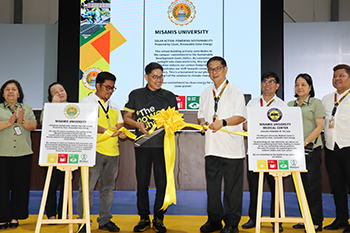 Turnover of solar energy management from WEGEN to MU |
Videos

|

|

|