








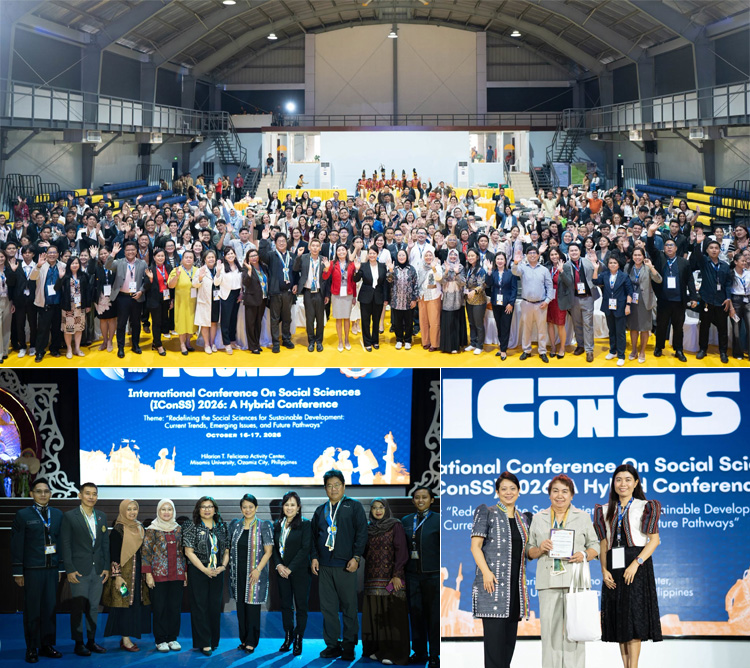
Redefining the Social Sciences: Misamis University Welcomes Global Scholars to IConSS 2026


Misamis University successfully hosted the 1st International Conference on Social Sciences (IConSS 2026): A Hybrid Conference on October 16–17, 2026, at the H. T. Feliciano Activity Center in Ozamiz City, Philippines, with the theme “Redefining the Social Sciences for Sustainable Development: Current Trends, Emerging Issues, and Future Pathways.”
Organized in collaboration with Universitas Amikom Purwokerto, Universitas Serang Raya, and Universitas Brawijaya of Indonesia, and José Rizal University of Manila, IConSS 2026 brought together researchers, academics, professionals, and students from the Philippines and abroad to exchange knowledge and explore solutions to contemporary social challenges.
The conference recorded 244 abstract submissions and papers presented, 814 face-to-face participants, 266 online participants, and 67 participating institutions and agencies from the Philippines and other countries. Discussions covered diverse fields of the Social Sciences and emphasized their contribution to the United Nations Sustainable Development Goals (SDGs), particularly quality education, gender equality, reduced inequalities, sustainable communities, peace, justice, and strong institutions.
The conference featured Professor Fay Rola-Rubzen, PhD, Dean of Research, Faculty of Business and Law, Curtin University, Australia, as keynote speaker. Distinguished plenary speakers included Dr. Takashi Tsuji of Obihiro University of Agriculture and Veterinary Medicine, Japan; Dr. Korakit Choomgrant of Kasetsart University, Thailand; Dr. Gideon D. Lasco of the University of the Philippines Diliman; and Dr. Chanell Jan C. Concepcion of Metro Pacific Health, Philippines.